
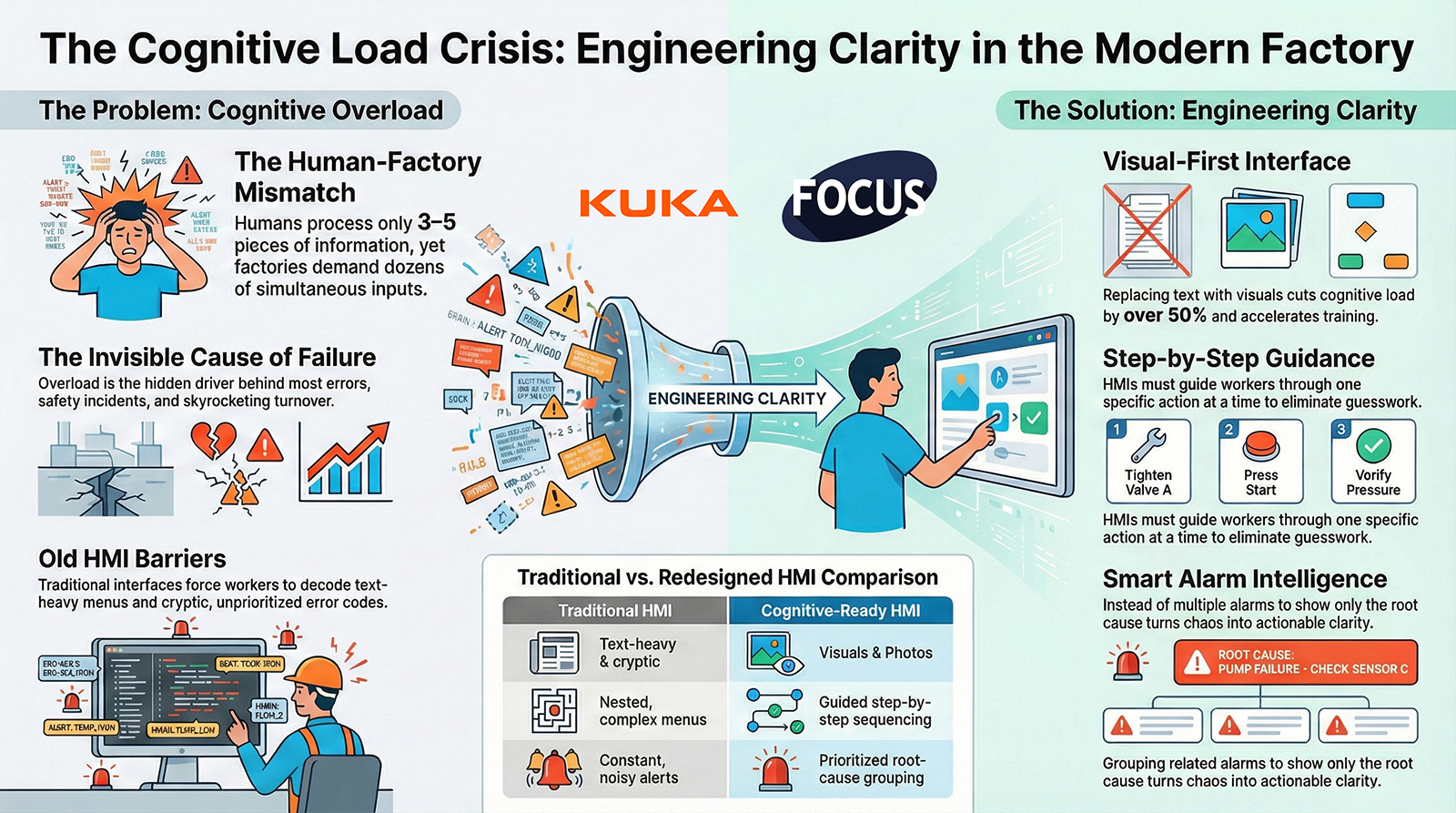
The Cognitive Load Crisis:
Why Modern Factories Are Overwhelming Workers (and How HMIs Must Fix It)**
Executive Summary
The modern factory has evolved faster than the human mind’s ability to keep up.
Automation has accelerated.
Production has intensified.
Complexity has multiplied.
Turnover has skyrocketed.
But human cognitive limits have not changed.
Operators, technicians, and supervisors are drowning in:
- Alarms
- Data
- Steps
- Screens
- Instructions
- Decisions
- Distractions
- Variability
- Pressure
This overload creates errors, slows production, causes safety incidents, increases scrap, and drives people out of the industry.
This is not a performance problem.
This is not a training problem.
This is not a motivation problem.
This is a cognitive load problem — and modern HMIs must be redesigned to solve it.
- Humans Have Cognitive Limits — Factories Act Like They Don’t
The human brain can only process:
- 3–5 pieces of new information at one time
- Simple sequences
- Clear visuals
- Low ambiguity
- Tasks with immediate feedback
But factories expect workers to juggle:
✔ Dozens of screens
✔ Multiple simultaneous alarms
✔ Complex mechanical understanding
✔ Tribal instructions
✔ Machine timing
✔ Quality expectations
✔ Safety rules
✔ Changeover steps
✔ Downtime pressure
The mismatch between expectation and ability is the root of modern operational chaos.
- Cognitive Overload Causes Most Factory Problems
When workers are mentally overwhelmed, they:
❌ Make mistakes
❌ Forget steps
❌ Miss cues
❌ React slowly
❌ Skip instructions
❌ Trigger faults
❌ Misinterpret alarms
❌ Perform unsafe actions
❌ Lose confidence
❌ Quit
Cognitive overload is not visible —
it’s not like a broken machine or a red alarm light —
but it is the invisible force behind most operational instability.
- Old HMIs Make Cognitive Load Worse
Traditional HMIs were built for engineers:
- Tiny buttons
- Text-heavy screens
- Nested menus
- Cryptic errors
- Parameter overload
- No visual hierarchy
- No prioritization
- No sequencing
- No simplification
These interfaces increase cognitive load by forcing workers to interpret, decode, remember, and guess.
This is unacceptable in the modern factory.
- The Cognitive Load Crisis Hits New Workers the Hardest
New workers:
- Have no tribal knowledge
- Are less mechanically familiar
- Need visual learning
- Are overwhelmed by too much text
- Lose confidence quickly
- Leave if the job feels chaotic
If a new worker is overloaded in the first hour,
they will not survive the first week.
The HMI must make the factory understandable to the inexperienced instantly.
- Cognitive Load Must Be Engineered Down at the Interface Level
The only scalable solution is to redesign HMIs to:
✔ Reduce information quantity
✔ Prioritize essential tasks
✔ Show only what matters now
✔ Use visuals instead of text
✔ Guide step-by-step
✔ Predict what the user needs
✔ Block incorrect actions
✔ Minimize decision-making
✔ Highlight the critical path
✔ Reduce noise from alarms
This is how you engineer clarity.
This is how you reduce cognitive demand.
- The HMI Must Tell Workers EXACTLY What to Do — One Step at a Time
Cognitive load drops dramatically when workers are not asked to:
- Remember sequences
- Interpret ambiguous instructions
- Decode technical jargon
- Navigate unfamiliar screens
- Make high-risk decisions under pressure
A modern HMI should guide:
✔ Step 1 → do this
✔ Step 2 → now this
✔ Step 3 → verify
✔ Step 4 → confirm
Nothing more.
Nothing less.
Nothing confusing.
This transforms performance.
- Visual-First Design Cuts Cognitive Load by Over 50%
When you replace text with visuals:
- Recognition replaces interpretation
- Processing is instant
- Error rates drop
- Training accelerates
- Stress levels fall
- Memory burden disappears
Examples:
- Green check / red X visuals
- Animated steps
- Photos of correct positions
- Side-by-side quality comparisons
- Highlighted sensor locations
- Visual zone maps
Humans are visual.
HMIs must reflect that.
- Smarter Alarm Systems Reduce Cognitive Load During Chaos
Alarms overwhelm workers:
- Too many
- Too cryptic
- Too technical
- Too frequent
- Too urgent
- Too unclear
Modern alarm intelligence:
✔ Groups related alarms
✔ Prioritizes the root cause
✔ Hides nuisance alarms
✔ Shows only the actionable step
✔ Provides a visual recovery guide
This turns alarm storms into clarity storms.
- Reducing Cognitive Load Increases Speed, Quality, and Safety
When cognitive load is low:
✔ Operators move faster
✔ Recovery times shrink
✔ Mistakes disappear
✔ Safety improves
✔ Training becomes easy
✔ Turnover drops
✔ Consistency rises
✔ Confidence skyrockets
Humans perform at their best when the system supports them instead of overwhelming them.
**10. Conclusion:
Solving the Cognitive Load Crisis Is the Key to the Modern Factory**
Factories don’t fail because people are bad at their jobs.
Factories fail because systems overwhelm people.
The Cognitive Load Crisis is the invisible barrier stopping:
- Training effectiveness
- Standard work
- Safety culture
- Quality performance
- Operational speed
- Employee retention
- Automation readiness
Modern HMIs can fix this by:
✔ Simplifying
✔ Visualizing
✔ Prioritizing
✔ Sequencing
✔ Predicting
✔ Guiding
✔ Supporting
This is not a UX upgrade.
This is a workforce revolution.
Reducing cognitive load is how factories survive the next decade.
FOCUS Integration – Episode 5 – Cognitive Load Crisis (Video Notes)
FOCUS Integration – Episode 5 – Cognitive Load Crisis (Audio Notes)