5 Signs Your Manufacturing Process Needs Automation
Modern manufacturing rarely breaks overnight. It doesn’t collapse—it erodes. Small inefficiencies stack up. Processes slow down. Costs creep up. Quality fluctuates. And before long, what used to work just… doesn’t anymore.
The challenge is that many of these issues feel “normal” because they develop gradually. Teams adapt. Workarounds become standard practice. Problems get patched instead of solved.
Automation is often seen as a big leap—but in reality, it’s usually the logical next step when your current process has outgrown itself.
If you’re unsure whether it’s time, here are five clear, real-world signs that your operation is ready for automation.
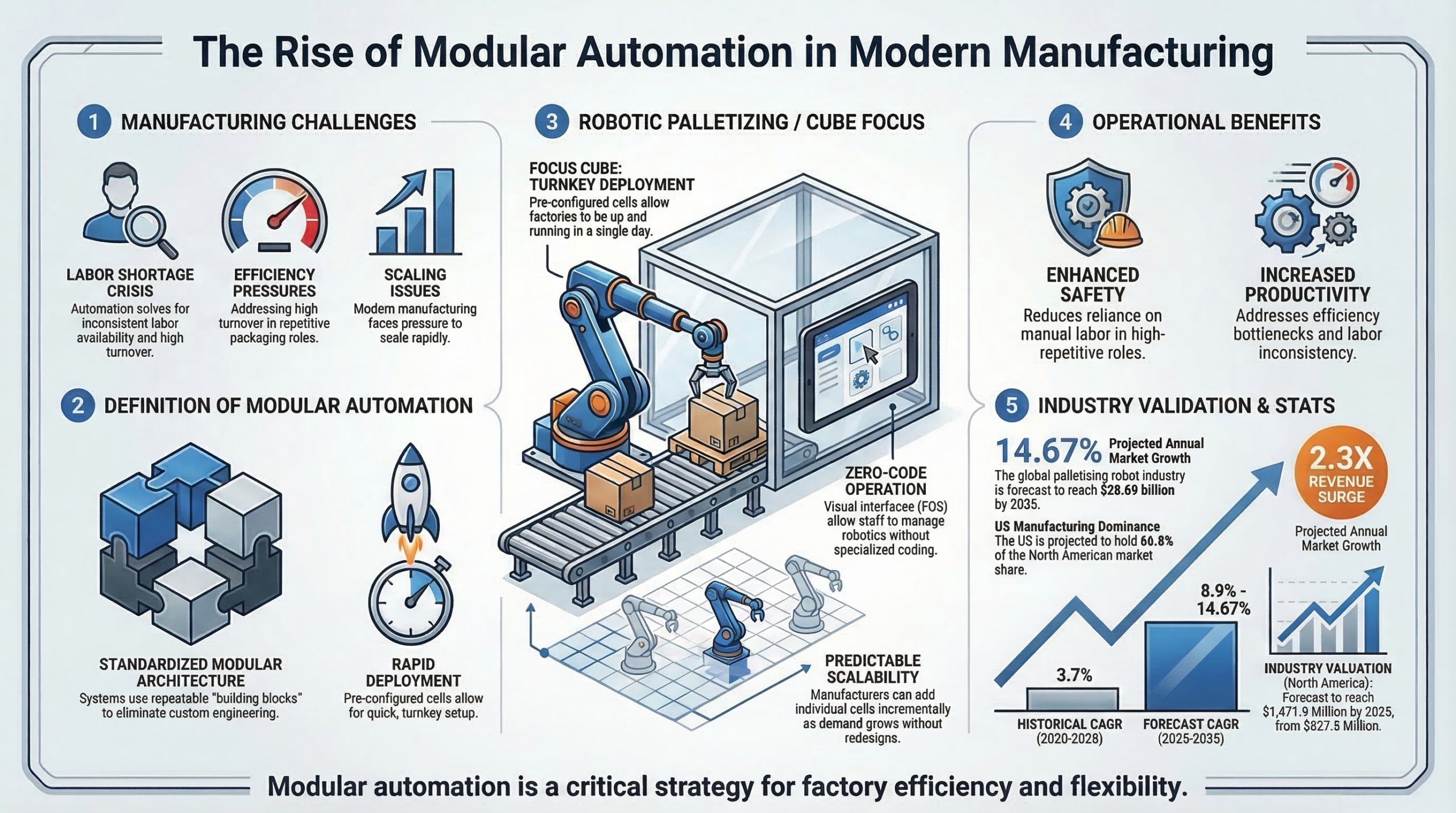
1. Labor Bottlenecks Are Limiting Your Output
One of the clearest indicators that you need automation is when your production capacity is directly tied to how many people you can put on the floor.
At first, this might not seem like a problem. Hiring more workers feels like a straightforward solution. But over time, you start to notice constraints:
- You can’t hire fast enough to meet demand
- Training new employees slows down production
- Overtime becomes the only way to keep up
- Productivity varies widely between shifts
This creates a ceiling on your output—one that becomes increasingly difficult (and expensive) to break through.
Automation changes this dynamic entirely.
Instead of scaling production by adding labor, you scale by increasing system capacity. A well-designed automated system can run continuously, maintain consistent cycle times, and eliminate the variability that comes with manual processes.
More importantly, it gives you predictability.
When your output is predictable, you can:
- Commit to tighter delivery timelines
- Take on larger contracts with confidence
- Plan production schedules more effectively
If your growth is being limited by how many people you can hire, you’re not dealing with a staffing issue—you’re dealing with a scalability problem. And that’s exactly what automation solves.
2. High Turnover in Repetitive or Physically Demanding Roles
There’s a reason certain positions are always open.
Repetitive, physically demanding jobs—like palletizing, material handling, or machine tending—tend to have the highest turnover rates in manufacturing environments.
These roles often involve:
- Repeating the same motion hundreds or thousands of times per shift
- Lifting heavy or awkward loads
- Working in uncomfortable or hazardous conditions
- Limited opportunity for skill development
Even your best employees will struggle to stay engaged in these positions long-term.
The result?
- Constant hiring cycles
- Ongoing training costs
- Lower overall team experience levels
- Increased risk of errors and accidents
This isn’t just a workforce issue—it’s an operational inefficiency.
Automation allows you to remove people from the roles that are hardest to retain and hardest on the body, and reallocate them to positions that require judgment, problem-solving, and oversight.
Instead of asking:
“Who can we hire to do this job?”
You start asking:
“Should a person be doing this job at all?”
Companies that make this shift often see:
- Improved employee retention
- Higher job satisfaction
- Stronger team performance overall
Because the reality is—automation doesn’t eliminate jobs. It eliminates the least sustainable ones.
3. Inconsistent Product Quality and Process Variability
In manufacturing, consistency is everything.
But manual processes introduce variability—no matter how skilled your workforce is.
Different operators perform tasks slightly differently:
- Placement might be off by a fraction
- Timing might vary between cycles
- Fatigue can impact precision over time
Individually, these differences seem minor. But over thousands of cycles, they add up to:
- Increased scrap rates
- Rework
- Customer complaints
- Quality control bottlenecks
And perhaps most importantly—lost trust.
Automation excels in environments where repeatability matters.
A properly designed system will:
- Perform the same motion the same way every time
- Maintain consistent cycle timing
- Reduce reliance on manual adjustments
This doesn’t just improve quality—it stabilizes your entire process.
When your process is stable:
- Quality becomes predictable
- Inspection becomes easier
- Waste is reduced
- Customer confidence increases
It’s important to note that automation doesn’t just fix bad processes—it reveals them. That’s a good thing.
Because once variability is removed, you can clearly see where improvements need to be made.
If your team spends a significant amount of time managing inconsistencies instead of producing output, it’s a strong signal that automation could bring immediate value.
4. Safety Risks Are Becoming a Concern
Safety isn’t just a compliance issue—it’s a business issue.
In many manufacturing environments, certain tasks inherently carry risk:
- Repetitive lifting and strain injuries
- Interaction with heavy machinery
- Exposure to hazardous materials
- Awkward or confined working positions
Even with proper training and PPE, these risks don’t disappear—they’re just managed.
And over time, they add up:
- Workplace injuries
- Increased insurance costs
- Lost productivity
- Lower employee morale
Automation offers a way to remove people from the most dangerous parts of the process entirely.
Robots don’t get tired. They don’t lose focus. They don’t take shortcuts.
They’re ideal for:
- Heavy lifting
- Repetitive motion
- High-temperature or hazardous environments
- High-speed operations
By automating high-risk tasks, you’re not just improving safety—you’re creating a more sustainable workplace.
And that has ripple effects:
- Employees feel more valued and protected
- Retention improves
- Your company becomes more attractive to new hires
In today’s labor market, that matters more than ever.
If safety incidents—or even near-misses—are becoming more frequent, it’s not just a warning sign. It’s a call to action.
5. You’re Losing Business Due to Lead Times or Capacity Constraints
This is often the tipping point.
You’re getting opportunities—but you can’t take full advantage of them.
Maybe:
- Your lead times are longer than competitors
- You’re turning down work because you’re at capacity
- Customers are asking for faster turnaround than you can deliver
- Your team is constantly in “catch-up mode”
At this stage, the cost of not automating becomes very real.
Because every missed opportunity is:
- Lost revenue
- Lost market share
- Potentially lost long-term customers
Automation allows you to compress timelines and increase responsiveness.
Instead of reacting to demand, you can keep up with it—or even stay ahead of it.
Faster production cycles mean:
- Shorter lead times
- Greater flexibility
- Ability to handle rush orders
- More competitive positioning
And in many industries, speed is the differentiator.
It’s not just about who can produce—it’s about who can deliver fastest and most reliably.
If your sales team is being held back by your production capabilities, automation isn’t just an operational upgrade—it’s a growth strategy.
The Bigger Picture: Automation as a Strategic Shift
Each of these signs—labor bottlenecks, turnover, inconsistency, safety concerns, and missed opportunities—points to the same underlying issue:
Your current process has reached its limit.
Automation isn’t about replacing people or chasing trends. It’s about removing the constraints that prevent your business from growing.
It allows you to:
- Scale without chaos
- Improve without overloading your team
- Compete in a faster, more demanding market
And perhaps most importantly—it gives you control.
Instead of constantly reacting to problems, you can design a system that works by default.
Final Thought
Most companies wait too long to automate.
They wait until problems become urgent. Until inefficiencies become costly. Until opportunities are already lost.
But the companies that win are the ones that recognize the signs early—and act on them.
If even one of these challenges feels familiar, it’s worth taking a closer look at your process.
Because the question isn’t:
“Can we afford to automate?”
It’s:
“How long can we afford not to?”
FOCUS Integration – 5 Signs Your Manufacturing Process Needs Automation (Video Notes)
FOCUS Integration – 5 Signs Your Manufacturing Process Needs Automation (Audio Notes)