One-Day Factory Upgrade:

How Modern Automation, Smart Interfaces, and Prebuilt Systems Enable Rapid Transformation**

Executive Summary

Factories used to think upgrades required:

  • Weeks of shutdown
  • Dozens of contractors
  • Complex wiring
  • Slow debugging
  • Endless paperwork
  • Painful retraining
  • Full workflow redesign

That era is gone.

The modern manufacturing world demands upgrades that happen in hours — not weeks.

The One-Day Factory Upgrade is not science fiction.
It is the natural result of:

  • Modular automation
  • Prevalidated logic
  • Plug-and-play electrical design
  • Standardized mechanical interfaces
  • Smart HMIs
  • Guided startup workflows
  • Factory-wide visualization
  • Real-time telemetry

This episode explains how a factory can transform fast, safely, and without shutting down for days.

  1. Traditional Factory Upgrades Are Too Slow for Modern Manufacturing

Legacy upgrade models involve:

  • Long installation windows
  • Manual rework
  • Tribal commissioning
  • Slow troubleshooting
  • Inconsistent knowledge transfer
  • Complicated changeovers
  • Overwhelming training demands

These delays destroy:

  • Throughput
  • Labor availability
  • Production schedules
  • On-time delivery
  • Customer confidence
  • Profit margins

The One-Day Factory Upgrade eliminates this entirely.

  1. The One-Day Upgrade Is Made Possible by Pre-Engineered, Modular Systems

The secret is NOT working faster.
The secret is redesigning automation so it doesn’t require long installations at all.

Modern upgrade-ready systems include:

✔ Prewired panels

✔ Prefabricated robot assemblies

✔ Pretested safety circuits

✔ Modular conveyors

✔ Prebuilt pneumatic packages

✔ Standardized I/O blocks

✔ Quick-connect field devices

✔ Drop-in robot programs

✔ Universal mounting points

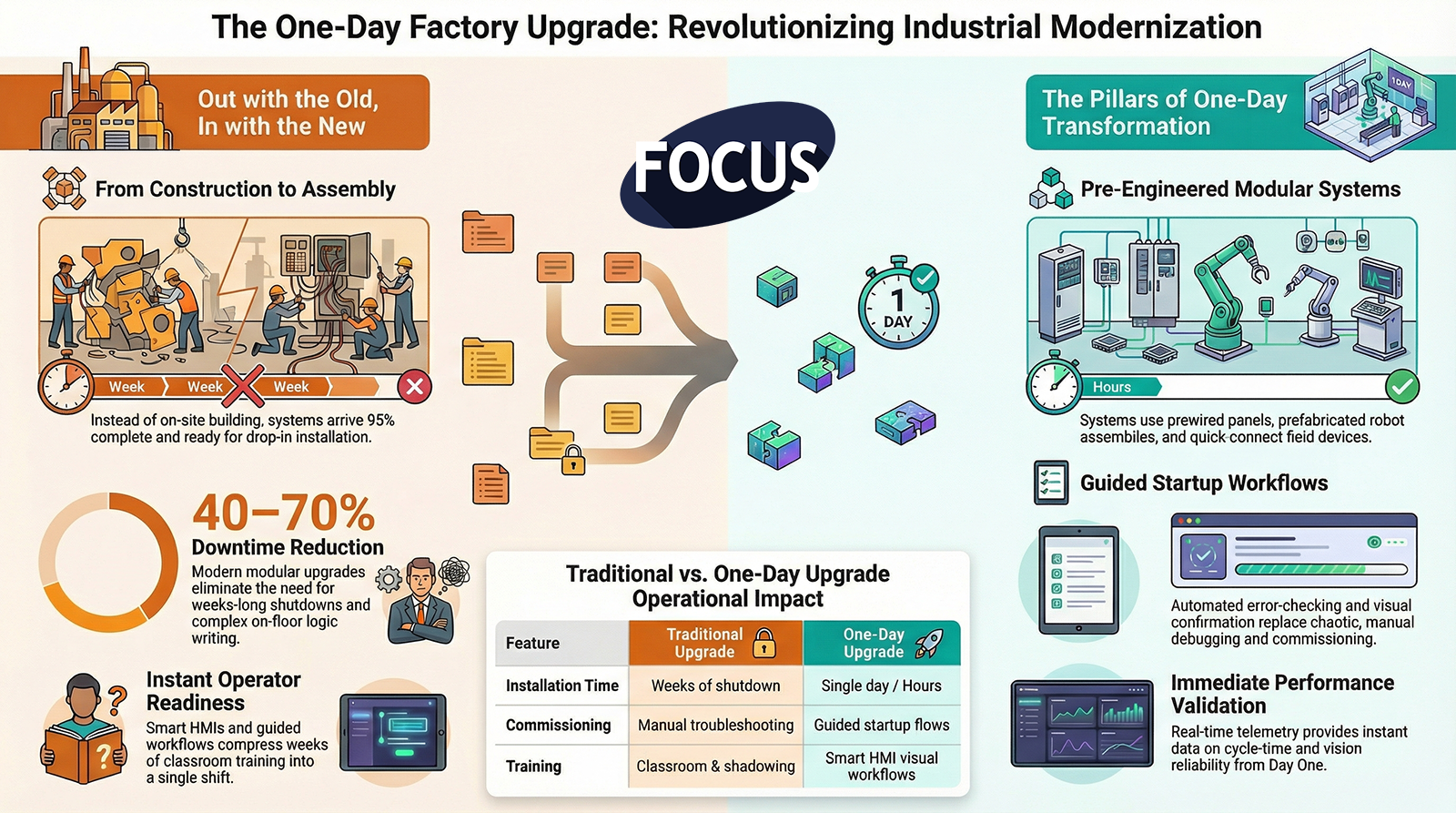
Instead of building on-site, the factory receives a system that is 95% complete before it arrives.

Installation becomes assembly, not construction.

  1. Guided Startup Workflows Replace the Painful Commissioning Process

Commissioning used to take days because:

  • Technicians weren’t aligned
  • Logic had to be tuned
  • Operators didn’t understand the system
  • Faults weren’t predictable
  • Manuals were unclear
  • Training was nonexistent
  • Debugging was chaotic

The One-Day Upgrade uses:

✔ Step-by-step startup flows

✔ Visual confirmation checks

✔ Auto-detection of sensors and devices

✔ Preconfigured motion profiles

✔ Automated error-checking

✔ Standardized commissioning sequences

Debug is finished before the system even arrives.

Startup becomes a guided process —
not a stressful marathon.

  1. Smart HMIs Compress Weeks of Training Into a Single Shift

Operators normally need:

  • Classroom sessions
  • Job shadowing
  • Tribal walkthroughs
  • Hands-on repetition
  • Multiple mistakes
  • Confidence building

Smart HMIs eliminate all of that.

The One-Day Upgrade includes HMIs with:

✔ Visual workflows

✔ Guided operation

✔ Animated changeover steps

✔ Standard recovery sequences

✔ Predictive fault insights

✔ Role-based layers

✔ Real-time clarity

This makes even complex automation approachable for new workers the moment it lands on the floor.

  1. Telemetry Confirms the Upgrade Works Immediately

In a traditional upgrade, engineers wait:
“Does it actually perform?
Is the cycle stable?
Are sensors reliable?
Is the robot tuned?”

Telemetry answers those questions instantly:

✔ Cycle-time readiness

✔ Component health

✔ Alarm clustering

✔ Load monitoring

✔ Vision reliability

✔ Operator interaction data

✔ Predictive signals

The system doesn’t need weeks to prove itself —
it demonstrates stability on Day One.

  1. The One-Day Factory Upgrade Minimizes Disruption and Maximizes Productivity

Old upgrade model:

❌ Shut down for days

❌ Move machines

❌ Rewire everything

❌ Rebuild infrastructure

❌ Write logic on the floor

❌ Stress the workforce

❌ Train while running

The One-Day Upgrade:

✔ Drop-in installation

✔ Minimal downtime

✔ Predictive startup

✔ Guided workflows

✔ Real-time validation

✔ Instant operator readiness

✔ Seamless integration

The line doesn’t stop for a week.
It pauses for a moment —
then becomes better than before.

  1. Why the One-Day Upgrade Is Not Optional — It’s the Future Standard

Manufacturers now face:

  • Unpredictable demand
  • Rapid production shifts
  • Frequent product changes
  • Labor scarcity
  • Tight customer deadlines
  • Increased automation dependency

They no longer have the luxury of long shutdowns.

The future factory requires systems that are:

✔ Fast to install

✔ Fast to start

✔ Fast to teach

✔ Fast to adjust

✔ Fast to maintain

✔ Fast to grow

The One-Day Upgrade is the only model that fits this reality.

  1. The One-Day Upgrade Supports the Entire Modern Factory Philosophy

This concept ties directly to:

  • Visual Factory 3.0
  • Cognitive Load Reduction
  • Rapid Training Evolution
  • Multi-layered interfaces
  • HMI telemetry
  • Predictive interaction
  • Factory-wide digital OS
  • Automation Without Confusion

Everything works because every part of the system is aligned around simplicity, clarity, and speed.

  1. Case Studies Already Prove the Model Works

Factories that have adopted the one-day upgrade model report:

✔ Immediate throughput increases

✔ Same-day training success

✔ Faster shift transitions

✔ 40–70% downtime reduction

✔ Drastically fewer mistakes

✔ Higher operator confidence

✔ Lower turnover

✔ Predictable maintenance

Results that used to take months now happen in one shift.

**10. Conclusion:

The Future of Manufacturing Will Be Upgraded in a Single Day**

Factories can no longer afford slow modernization.

They need speed.
They need clarity.
They need predictability.
They need guided workflows.
They need visual systems.
They need better HMIs.
They need smarter automation.
They need tech that can be installed, learned, and trusted instantly.

The One-Day Factory Upgrade is the new standard.

Not someday.
Today.


FOCUS Integration – Episode 6 – The One-Day Factory Upgrade (Video Notes)

FOCUS Integration – Episode 5 – Cognitive Load Crisis (Audio Notes)
Cognitive Load Crisis

The Cognitive Load Crisis:

Why Modern Factories Are Overwhelming Workers (and How HMIs Must Fix It)**

Executive Summary

The modern factory has evolved faster than the human mind’s ability to keep up.

Automation has accelerated.
Production has intensified.
Complexity has multiplied.
Turnover has skyrocketed.

But human cognitive limits have not changed.

Operators, technicians, and supervisors are drowning in:

  • Alarms
  • Data
  • Steps
  • Screens
  • Instructions
  • Decisions
  • Distractions
  • Variability
  • Pressure

This overload creates errors, slows production, causes safety incidents, increases scrap, and drives people out of the industry.

This is not a performance problem.
This is not a training problem.
This is not a motivation problem.

This is a cognitive load problem — and modern HMIs must be redesigned to solve it.

  1. Humans Have Cognitive Limits — Factories Act Like They Don’t

The human brain can only process:

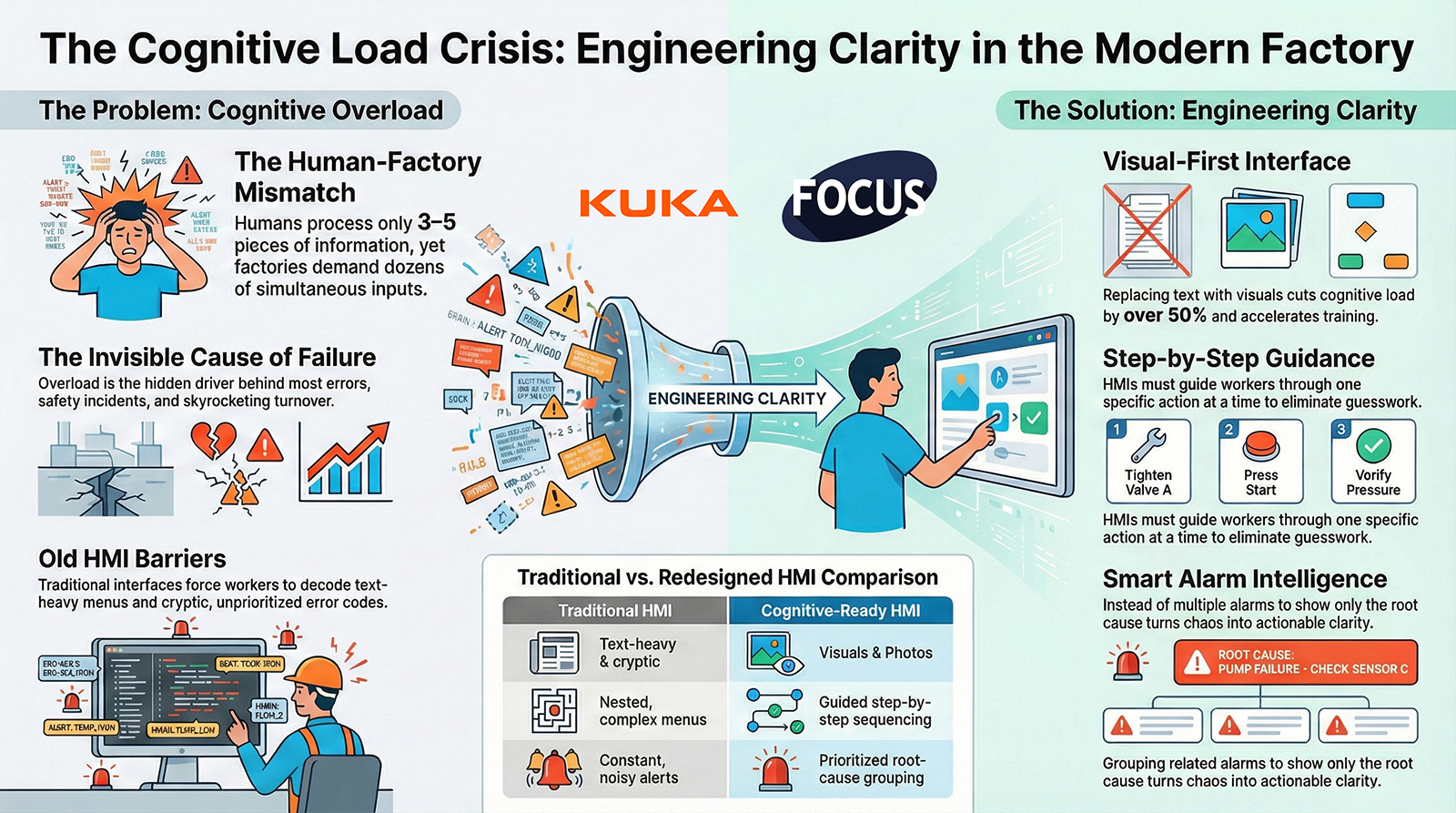
  • 3–5 pieces of new information at one time
  • Simple sequences
  • Clear visuals
  • Low ambiguity
  • Tasks with immediate feedback

But factories expect workers to juggle:

✔ Dozens of screens

✔ Multiple simultaneous alarms

✔ Complex mechanical understanding

✔ Tribal instructions

✔ Machine timing

✔ Quality expectations

✔ Safety rules

✔ Changeover steps

✔ Downtime pressure

The mismatch between expectation and ability is the root of modern operational chaos.

  1. Cognitive Overload Causes Most Factory Problems

When workers are mentally overwhelmed, they:

❌ Make mistakes

❌ Forget steps

❌ Miss cues

❌ React slowly

❌ Skip instructions

❌ Trigger faults

❌ Misinterpret alarms

❌ Perform unsafe actions

❌ Lose confidence

❌ Quit

Cognitive overload is not visible —
it’s not like a broken machine or a red alarm light —
but it is the invisible force behind most operational instability.

  1. Old HMIs Make Cognitive Load Worse

Traditional HMIs were built for engineers:

  • Tiny buttons
  • Text-heavy screens
  • Nested menus
  • Cryptic errors
  • Parameter overload
  • No visual hierarchy
  • No prioritization
  • No sequencing
  • No simplification

These interfaces increase cognitive load by forcing workers to interpret, decode, remember, and guess.

This is unacceptable in the modern factory.

  1. The Cognitive Load Crisis Hits New Workers the Hardest

New workers:

  • Have no tribal knowledge
  • Are less mechanically familiar
  • Need visual learning
  • Are overwhelmed by too much text
  • Lose confidence quickly
  • Leave if the job feels chaotic

If a new worker is overloaded in the first hour,
they will not survive the first week.

The HMI must make the factory understandable to the inexperienced instantly.

  1. Cognitive Load Must Be Engineered Down at the Interface Level

The only scalable solution is to redesign HMIs to:

✔ Reduce information quantity

✔ Prioritize essential tasks

✔ Show only what matters now

✔ Use visuals instead of text

✔ Guide step-by-step

✔ Predict what the user needs

✔ Block incorrect actions

✔ Minimize decision-making

✔ Highlight the critical path

✔ Reduce noise from alarms

This is how you engineer clarity.

This is how you reduce cognitive demand.

  1. The HMI Must Tell Workers EXACTLY What to Do — One Step at a Time

Cognitive load drops dramatically when workers are not asked to:

  • Remember sequences
  • Interpret ambiguous instructions
  • Decode technical jargon
  • Navigate unfamiliar screens
  • Make high-risk decisions under pressure

A modern HMI should guide:

✔ Step 1 → do this

✔ Step 2 → now this

✔ Step 3 → verify

✔ Step 4 → confirm

Nothing more.
Nothing less.
Nothing confusing.

This transforms performance.

  1. Visual-First Design Cuts Cognitive Load by Over 50%

When you replace text with visuals:

  • Recognition replaces interpretation
  • Processing is instant
  • Error rates drop
  • Training accelerates
  • Stress levels fall
  • Memory burden disappears

Examples:

  • Green check / red X visuals
  • Animated steps
  • Photos of correct positions
  • Side-by-side quality comparisons
  • Highlighted sensor locations
  • Visual zone maps

Humans are visual.
HMIs must reflect that.

  1. Smarter Alarm Systems Reduce Cognitive Load During Chaos

Alarms overwhelm workers:

  • Too many
  • Too cryptic
  • Too technical
  • Too frequent
  • Too urgent
  • Too unclear

Modern alarm intelligence:

✔ Groups related alarms

✔ Prioritizes the root cause

✔ Hides nuisance alarms

✔ Shows only the actionable step

✔ Provides a visual recovery guide

This turns alarm storms into clarity storms.

  1. Reducing Cognitive Load Increases Speed, Quality, and Safety

When cognitive load is low:

✔ Operators move faster

✔ Recovery times shrink

✔ Mistakes disappear

✔ Safety improves

✔ Training becomes easy

✔ Turnover drops

✔ Consistency rises

✔ Confidence skyrockets

Humans perform at their best when the system supports them instead of overwhelming them.

**10. Conclusion:

Solving the Cognitive Load Crisis Is the Key to the Modern Factory**

Factories don’t fail because people are bad at their jobs.
Factories fail because systems overwhelm people.

The Cognitive Load Crisis is the invisible barrier stopping:

  • Training effectiveness
  • Standard work
  • Safety culture
  • Quality performance
  • Operational speed
  • Employee retention
  • Automation readiness

Modern HMIs can fix this by:

✔ Simplifying

✔ Visualizing

✔ Prioritizing

✔ Sequencing

✔ Predicting

✔ Guiding

✔ Supporting

This is not a UX upgrade.
This is a workforce revolution.

Reducing cognitive load is how factories survive the next decade.


FOCUS Integration – Episode 5 – Cognitive Load Crisis (Video Notes)


FOCUS Integration – Episode 5 – Cognitive Load Crisis (Audio Notes)
 

The Global Automation Arms Race:

Why Waiting Is the Most Expensive Strategy in Modern Manufacturing**

Executive Summary

There is a global shift happening right now — a rapid acceleration in industrial automation, robotics adoption, and factory digitalization. It is not slowing down. It is not a trend. It is an economic reality reshaping the competitive landscape of manufacturing.

Countries that automate faster are increasing their productivity, lowering labor dependency, strengthening supply chains, improving quality, and reducing operational risk. Those that delay are losing market share, struggling with workforce shortages, and becoming dependent on external suppliers.

This is the Global Automation Arms Race — and manufacturers who wait will pay more, struggle more, and lose more.

Today, automation alone is not enough. The winners in this new era pair robotics with a connected workforce, real-time data visibility, and a unified digital operating system that allows them to run their operations with precision, clarity, and resilience.

The message is clear:
The cost of waiting is far higher than the cost of transforming.

  1. The Hard Numbers: Who Is Automating — and How Fast

Industrial automation is expanding at unprecedented velocity, especially in Asia.

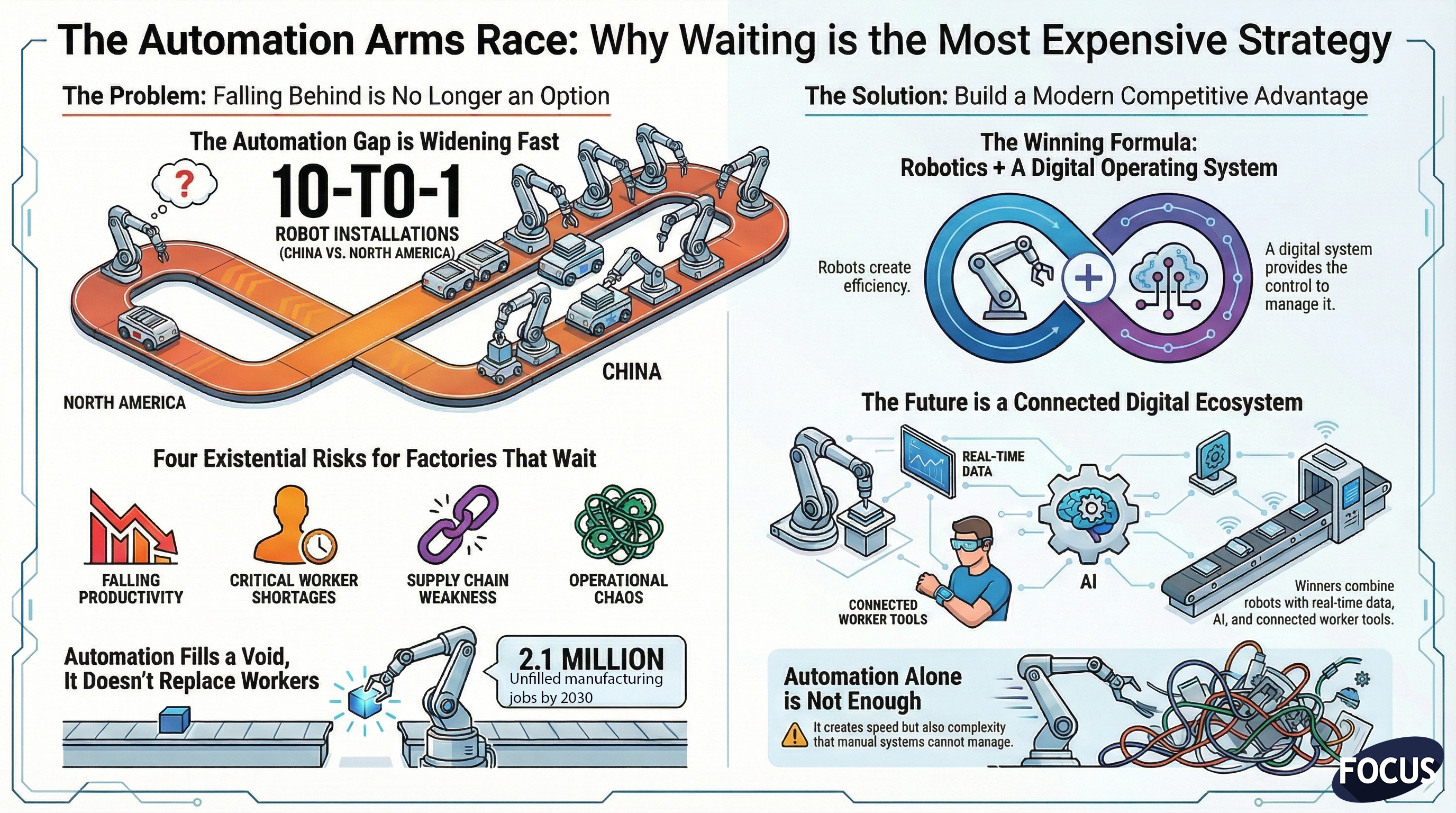
China is leading the world by a staggering margin.

  • Installs over 295,000 industrial robots per year
  • Represents ~54% of global robot installations
  • Domestic robot manufacturing has overtaken imports
  • Outpaces North America by nearly 10:1

Meanwhile, the U.S. installs roughly:

  • 34,000–40,000 robots annually
  • Growth is consistent but slow compared to global leaders

Other rapidly advancing nations include:

  • South Korea
  • Japan
  • Germany
  • Singapore
  • Taiwan

Every one of these countries is integrating automation and digital operating systems simultaneously — creating self-reinforcing competitive advantages.

  1. Why Automation Is No Longer Optional — It’s Survival

Manufacturers who delay automation and digital adoption face four existential risks:

Risk #1 — Falling Behind on Cost and Productivity

Countries that automate aggressively produce goods:

  • Faster
  • Cheaper
  • More consistently
  • With fewer labor constraints

This drives down global prices, making it nearly impossible for lower-automation regions to compete.

Risk #2 — Losing Skilled Workers Faster Than They Can Be Replaced

The U.S. alone is projected to have:

  • 2.1 million unfilled manufacturing jobs by 2030
  • A rapidly retiring workforce
  • High turnover in physically demanding jobs
  • Low interest from younger generations

Automation isn’t replacing workers — it’s filling a void that will never be filled by traditional hiring alone.

A factory that does not automate will not have enough workers to run.

Risk #3 — Supply Chain Realities Are Changing

Companies are reshoring and nearshoring to reduce geopolitical risk, but reshored facilities must be:

  • Highly automated
  • Digitally connected
  • Lean in labor requirements

Otherwise, they cannot compete with overseas counterparts that have lower labor costs and higher automation levels.

Risk #4 — Manual, Paper-Based Factories Cannot Keep Pace

Even automated plants fail if they run on:

  • Clipboards
  • Whiteboards
  • Spreadsheet-driven supervisors
  • Disconnected workflows
  • Tribal knowledge
  • Slow escalation paths

Modern operations require digital coordination to match digital machinery.
Machines run faster than humans can communicate — unless those humans are connected through a unified system.

  1. The New Reality: Automation Alone Is Not Enough

Automation creates capacity, speed, and safety.

But automation also increases:

  • Complexity
  • The rate of decisions required
  • The speed at which operations move
  • The number of scenarios an operator must manage
  • The need for real-time visibility across the plant

This is why leading manufacturers pair automation with a digital operating system that manages:

  • Visual management on large displays
  • Connected worker tools
  • Digital workflows
  • Escalation logic
  • Maintenance intelligence
  • Quality detection and response
  • Skills management
  • Machine-to-human communication

Robots create efficiency.
The OS creates control.

Together, they create competitiveness.

  1. The Cost of Waiting: What Happens to Companies That Delay Automation

Manufacturers who continue to “wait for the right time” face predictable outcomes:

  1. Rising Labor Costs and Shrinking Labor Pools

Competing for shrinking talent becomes expensive and unsustainable.

  1. Increased Safety Risk

Manual repetitive tasks create injuries, lawsuits, and insurance penalties.

  1. Competitive Irrelevance

Customers need suppliers who are stable, scalable, and accurate.

  1. Higher Production Costs

Low-automation factories cannot match the consistency or throughput of automated ones.

  1. Inability to Meet Demand During Surges

Manual systems crumble under variability.

  1. Slow Problem Detection

Paper-driven plants detect failures hours — or days — too late.

  1. Higher Scrap Rates

Without real-time feedback, quality issues spread rapidly.

By the time these plants try to catch up, their competitors have already accelerated innovation, reducing the window for recovery.

  1. The Global Leaders Are Building Entire Ecosystems — Not Just Installing Robots

The companies dominating the automation race don’t just install equipment — they build digital ecosystems around it.

These ecosystems include:

  • Autonomous conveyors and AGVs
  • Multi-line robotic systems
  • Vision-guided inspection
  • Real-time scheduling tools
  • Digital checklists and SOPs
  • Large-format displays with live KPIs
  • Integrated maintenance workflows
  • Predictive analytics
  • Skills matrices
  • AI-supported decision-making

This creates factories that:

  • Detect issues instantly
  • Resolve them faster
  • Train workers automatically
  • Maintain consistency across shifts
  • Scale best practices across sites
  • Improve continuously
  • Operate with fewer people and fewer delays

These ecosystems become self-reinforcing competitive engines.

  1. The Economics of Automation Have Changed — Forever

For years, automation was seen as a high-capex luxury.

Not anymore.

Major shifts have made automation far more accessible:

  • Lower robot costs
  • Faster deployment cycles
  • Payback periods under 12 months in many cases
  • Subscription-based models
  • Turnkey cell solutions
  • Pre-engineered automation kits
  • Modular palletizing systems
  • Integrated robotics + software bundles

But the largest ROI comes when automation is paired with:

  • Real-time visual management
  • Connected worker platforms
  • Digital procedures
  • Predictive maintenance tools
  • A unified operating system

The combination produces exponential returns — not additive ones.

  1. The U.S. Must Automate Faster or Lose Manufacturing Permanently

To remain competitive in the global market, manufacturers must:

  • Adopt robotics rapidly
  • Build digital operating systems
  • Connect frontline workers
  • Increase safety
  • Modernize communication
  • Reduce dependency on manual processes
  • Run plants with greater stability and fewer people

The automation gap between nations is widening.
Manufacturers who wait will not slowly fall behind — they will fall behind fast.

  1. What Leading Manufacturers Are Doing Right Now

Across North America, forward-thinking plants are:

  • Automating palletizing, packing, and repetitive tasks
  • Deploying AGVs/AMRs to eliminate forklift risk
  • Installing large-format digital visual boards
  • Implementing connected worker tools
  • Digitizing SOPs and standard work
  • Using AI-driven quality inspection
  • Integrating PLC data into unified dashboards
  • Deploying real-time Andon systems
  • Building private 5G networks
  • Adding edge compute systems
  • Developing multi-site digital standards

These actions are not optional upgrades — they are survival strategies.

  1. The Future: Factories Will Compete on How Quickly They Can Learn

This new era of manufacturing will not be won by:

  • The largest factory
  • The cheapest labor
  • The most automation

It will be won by the factory that learns the fastest — and learning requires:

  • Real-time visibility
  • Standardized digital processes
  • AI-assisted detection
  • Human + machine coordination
  • Shared operational truth
  • Rapid knowledge capture and distribution

A digital operating system is the foundation for this learning cycle.

Factories without this digital backbone will fall behind no matter how many robots they install.

**Conclusion:

The Most Expensive Strategy in the Automation Age Is Doing Nothing**

Manufacturers now operate in a world where:

  • Demand is volatile
  • Labor is scarce
  • Quality expectations are rising
  • Competition is global
  • Supply chains are fragile

Waiting to automate is not caution — it is risk.

Waiting to digitize is not prudence — it is decline.

The companies that win the automation race will be the ones that combine:

  • Robotics
  • Connected workers
  • Real-time data
  • Large-format visual systems
  • A unified operating platform

This is the modern competitive advantage.

The automation arms race has already begun.
The only question is whether manufacturers will lead, follow, or be left behind.


FOCUS Integration – Episode 4 –The Automation Arms Race (Video Notes)


FOCUS Integration – Episode 4 – The Automation Arms Race (Audio Notes)


beyond dashbaords

Beyond OEE Dashboards:

What a True Factory Operating System Should Actually Do**

Executive Summary

For years, manufacturers have been told that digital transformation begins with dashboards — colorful displays of OEE, downtime, scrap rates, and production numbers. And while dashboards are useful, they are also deeply limited.

Dashboards report.
Factories must operate.

A dashboard can tell you that production is behind.
A factory operating system (FOS) tells you why, what to do next, and who needs to do it.

Dashboards visualize data.
A factory operating system drives behavior.

Dashboards live in conference rooms and supervisor offices.
A factory operating system lives on the shop floor, powering decision-making for operators, technicians, supervisors, and leadership in real time.

This article explores why dashboards alone cannot unlock modern manufacturing performance — and what a real operating system must provide to make the factory safer, smarter, faster, and more resilient.

  1. The Problem with Dashboard-Centric Thinking

Over the past decade, many manufacturers invested heavily in:

  • OEE dashboards
  • Downtime reporting tools
  • Production-monitoring apps
  • Custom spreadsheets
  • Office-based KPI displays

But a shocking number of these systems have failed to deliver real value.

Why?

Because dashboards have three critical limitations:

Limitation #1 — Dashboards show the symptom, not the cause

A dashboard can tell you:

  • OEE dropped
  • Scrap spiked
  • Throughput slowed
  • Downtime increased

But dashboards do not tell you:

  • Who was involved
  • What happened before the issue
  • What procedure was followed
  • What operator actions led to the failure
  • Which workflow broke down
  • How the issue should be escalated

Dashboards are mirrors — not maps.

Limitation #2 — Dashboards don’t change operator behavior

Operators don’t stare at dashboards.
They stare at machines, parts, workstations, and paperwork.

By the time someone looks at the dashboard, the problem already happened.

Dashboards are backward-looking.
Factory operations must be forward-guiding.

Limitation #3 — Dashboards live in offices, not on the floor

Operators need:

  • Prompts
  • Warnings
  • Clear instructions
  • Escalation paths
  • Contextual guidance

Dashboards don’t provide these.

Most dashboards serve leadership, not frontline workers.

  1. What Is a Factory Operating System?

A factory operating system (FOS) is a unified digital layer that connects:

  • Machines
  • People
  • Data
  • Workflows
  • Safety systems
  • Quality systems
  • Material movement
  • Planning and scheduling
  • Training and procedures
  • Visual management boards

It replaces the patchwork of:

  • Clipboards
  • Whiteboards
  • Paper SOPs
  • Radio calls
  • Tribal knowledge
  • Disconnected software

with a single architecture that governs how the factory runs.

The FOS becomes the brain and nervous system of the plant — coordinating information flow and guiding action in real time.

  1. The Five Core Capabilities of a True Factory Operating System

Dashboards only provide one of these five.
A complete factory OS must do all of them.

  1. Real-Time Visibility (Dashboards + Visual Boards + Alerts)

Yes, dashboards matter — but in the context of a larger system.

A factory OS must:

  • Display live performance
  • Show safety and quality metrics
  • Highlight abnormalities instantly
  • Provide takt time tracking
  • Surface deviations visually on the shop floor

This is the information layer.

But it is not enough on its own.

  1. Standardized Workflows and Digital Procedures

A real factory cannot rely on memory or inconsistent training.

A true FOS must:

  • Deliver step-by-step instructions
  • Enforce sequence control
  • Provide verification steps
  • Allow quick updates to procedures
  • Record who did what and when
  • Support photos, videos, diagrams, and AR

This is the execution layer.

It ensures every worker performs the task correctly every time.

  1. Role-Based Guidance and Escalation

When something goes wrong, workers should not guess:

  • Who to call
  • What to do
  • Where to go
  • What standard to follow
  • What the priority is

A real operating system:

  • Offers guided troubleshooting
  • Auto-assigns the right responder
  • Sends multi-channel alerts
  • Displays the issue on nearby screens
  • Tracks response time
  • Ensures follow-through

This is the coordination layer.

It prevents chaos, confusion, and delay.

  1. Integrated Human + Machine Intelligence

A factory OS must combine:

  • Machine data (PLC signals, sensors)
  • Operator actions (inputs, responses, observations)
  • Environmental data
  • Quality measurements
  • Maintenance records

This enables:

  • Real root cause analysis
  • Predictive maintenance
  • Better staffing decisions
  • Quality interventions
  • Energy optimization

This is the insight layer.

Dashboards cannot do this alone — they only display the data, not integrate it into workflows.

  1. Continuous Improvement and Governance

A digital OS must support:

  • Kaizen
  • Tier meetings
  • Issue logging
  • Action item tracking
  • Multi-shift continuity
  • Skills matrices
  • Audit trails

It enforces the rhythm of improvement the same way an ERP enforces financial structure.

This is the governance layer.

It ensures the factory doesn’t drift into tribal processes or “hero culture.”

  1. The Key Insight: Dashboards Measure Performance — Operating Systems Improve It

A dashboard can show that downtime increased.
A real factory OS:

  • Shows the downtime
  • Identifies the cause
  • Traces operator actions
  • Triggers standard troubleshooting steps
  • Notifies the right person
  • Displays the escalation on big boards
  • Tracks progress
  • Captures lessons learned
  • Updates the workflow to prevent recurrence

Dashboards are passive.
A factory operating system is active.

Dashboards observe.
A factory OS intervenes.

  1. Why the Shift Away From Dashboard-Only Thinking Is Accelerating

Manufacturers are realizing that:

You cannot manage today’s workforce with yesterday’s tools.

Frontline workers need structured digital guidance, not analog instructions.

You cannot manage today’s automation with yesterday’s workflows.

Robot cells, AGVs, and complex machinery require coordinated responses, not manual improvisation.

You cannot manage today’s scheduling and demand with yesterday’s visibility.

Real-time data is essential for meeting takt, not historical reports.

A dashboard-only approach is like trying to run a modern car with only a speedometer — and none of the warning systems, navigation, automation, or driver assistance features.

  1. What the Factory of the Future Will Look Like

The next generation of factories will be built around:

A shared visual layer

Large screens showing live performance, safety, and priority signals for everyone.

A digital nervous system

Operators, machines, and workflows connected through one OS.

Automated coordination

Escalations routed intelligently by role and urgency.

Standardization across sites

One system, one language, one way of working.

Operators empowered with guidance

Not just told what happened — shown what to do.

Data becoming behavior

Not just numbers — actions.

The difference between a dashboard-driven plant and an OS-driven plant will soon be as dramatic as the difference between a flip phone and a smartphone.

Conclusion: Dashboards Are the Beginning, Not the Destination

Modern factories require more than visibility.
They require structure, coordination, and real-time behavior shaping.

A dashboard tells you what happened.
A factory operating system makes the right thing happen.

This is the future of operational excellence:

  • Connected
  • Guided
  • Standardized
  • Visualized
  • Coordinated
  • Scalable

Dashboards alone cannot transform a factory.
A factory OS can transform everything.


FOCUS Integration – Episode 3 – Beyond Dashboards (Video Notes)


FOCUS Integration – Episode 3 – Beyond Dashboards (Audio Notes)