
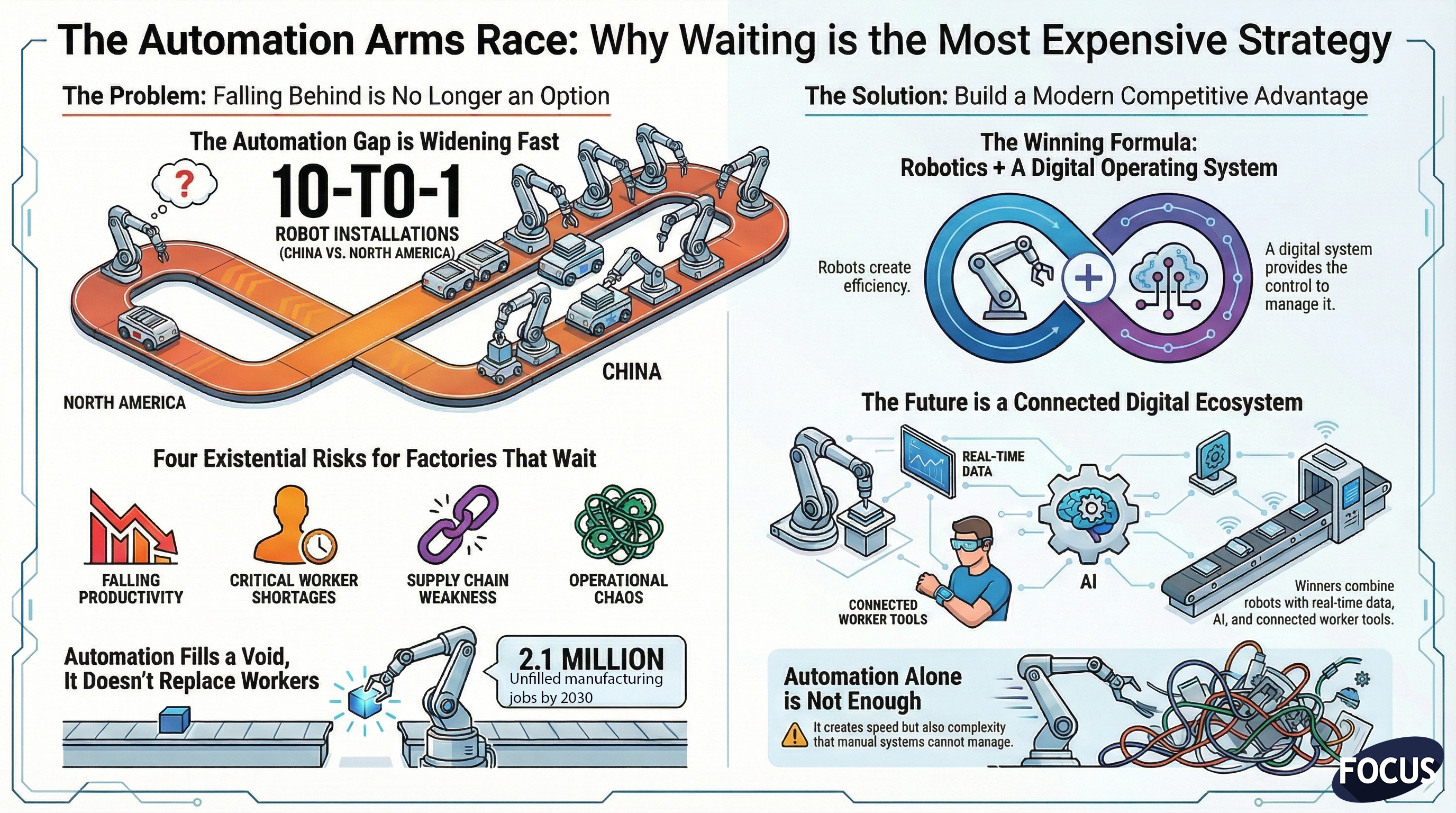
The Global Automation Arms Race:
Why Waiting Is the Most Expensive Strategy in Modern Manufacturing**
Executive Summary
There is a global shift happening right now — a rapid acceleration in industrial automation, robotics adoption, and factory digitalization. It is not slowing down. It is not a trend. It is an economic reality reshaping the competitive landscape of manufacturing.
Countries that automate faster are increasing their productivity, lowering labor dependency, strengthening supply chains, improving quality, and reducing operational risk. Those that delay are losing market share, struggling with workforce shortages, and becoming dependent on external suppliers.
This is the Global Automation Arms Race — and manufacturers who wait will pay more, struggle more, and lose more.
Today, automation alone is not enough. The winners in this new era pair robotics with a connected workforce, real-time data visibility, and a unified digital operating system that allows them to run their operations with precision, clarity, and resilience.
The message is clear:
The cost of waiting is far higher than the cost of transforming.
- The Hard Numbers: Who Is Automating — and How Fast
Industrial automation is expanding at unprecedented velocity, especially in Asia.
China is leading the world by a staggering margin.
- Installs over 295,000 industrial robots per year
- Represents ~54% of global robot installations
- Domestic robot manufacturing has overtaken imports
- Outpaces North America by nearly 10:1
Meanwhile, the U.S. installs roughly:
- 34,000–40,000 robots annually
- Growth is consistent but slow compared to global leaders
Other rapidly advancing nations include:
- South Korea
- Japan
- Germany
- Singapore
- Taiwan
Every one of these countries is integrating automation and digital operating systems simultaneously — creating self-reinforcing competitive advantages.
- Why Automation Is No Longer Optional — It’s Survival
Manufacturers who delay automation and digital adoption face four existential risks:
Risk #1 — Falling Behind on Cost and Productivity
Countries that automate aggressively produce goods:
- Faster
- Cheaper
- More consistently
- With fewer labor constraints
This drives down global prices, making it nearly impossible for lower-automation regions to compete.
Risk #2 — Losing Skilled Workers Faster Than They Can Be Replaced
The U.S. alone is projected to have:
- 2.1 million unfilled manufacturing jobs by 2030
- A rapidly retiring workforce
- High turnover in physically demanding jobs
- Low interest from younger generations
Automation isn’t replacing workers — it’s filling a void that will never be filled by traditional hiring alone.
A factory that does not automate will not have enough workers to run.
Risk #3 — Supply Chain Realities Are Changing
Companies are reshoring and nearshoring to reduce geopolitical risk, but reshored facilities must be:
- Highly automated
- Digitally connected
- Lean in labor requirements
Otherwise, they cannot compete with overseas counterparts that have lower labor costs and higher automation levels.
Risk #4 — Manual, Paper-Based Factories Cannot Keep Pace
Even automated plants fail if they run on:
- Clipboards
- Whiteboards
- Spreadsheet-driven supervisors
- Disconnected workflows
- Tribal knowledge
- Slow escalation paths
Modern operations require digital coordination to match digital machinery.
Machines run faster than humans can communicate — unless those humans are connected through a unified system.
- The New Reality: Automation Alone Is Not Enough
Automation creates capacity, speed, and safety.
But automation also increases:
- Complexity
- The rate of decisions required
- The speed at which operations move
- The number of scenarios an operator must manage
- The need for real-time visibility across the plant
This is why leading manufacturers pair automation with a digital operating system that manages:
- Visual management on large displays
- Connected worker tools
- Digital workflows
- Escalation logic
- Maintenance intelligence
- Quality detection and response
- Skills management
- Machine-to-human communication
Robots create efficiency.
The OS creates control.
Together, they create competitiveness.
- The Cost of Waiting: What Happens to Companies That Delay Automation
Manufacturers who continue to “wait for the right time” face predictable outcomes:
- Rising Labor Costs and Shrinking Labor Pools
Competing for shrinking talent becomes expensive and unsustainable.
- Increased Safety Risk
Manual repetitive tasks create injuries, lawsuits, and insurance penalties.
- Competitive Irrelevance
Customers need suppliers who are stable, scalable, and accurate.
- Higher Production Costs
Low-automation factories cannot match the consistency or throughput of automated ones.
- Inability to Meet Demand During Surges
Manual systems crumble under variability.
- Slow Problem Detection
Paper-driven plants detect failures hours — or days — too late.
- Higher Scrap Rates
Without real-time feedback, quality issues spread rapidly.
By the time these plants try to catch up, their competitors have already accelerated innovation, reducing the window for recovery.
- The Global Leaders Are Building Entire Ecosystems — Not Just Installing Robots
The companies dominating the automation race don’t just install equipment — they build digital ecosystems around it.
These ecosystems include:
- Autonomous conveyors and AGVs
- Multi-line robotic systems
- Vision-guided inspection
- Real-time scheduling tools
- Digital checklists and SOPs
- Large-format displays with live KPIs
- Integrated maintenance workflows
- Predictive analytics
- Skills matrices
- AI-supported decision-making
This creates factories that:
- Detect issues instantly
- Resolve them faster
- Train workers automatically
- Maintain consistency across shifts
- Scale best practices across sites
- Improve continuously
- Operate with fewer people and fewer delays
These ecosystems become self-reinforcing competitive engines.
- The Economics of Automation Have Changed — Forever
For years, automation was seen as a high-capex luxury.
Not anymore.
Major shifts have made automation far more accessible:
- Lower robot costs
- Faster deployment cycles
- Payback periods under 12 months in many cases
- Subscription-based models
- Turnkey cell solutions
- Pre-engineered automation kits
- Modular palletizing systems
- Integrated robotics + software bundles
But the largest ROI comes when automation is paired with:
- Real-time visual management
- Connected worker platforms
- Digital procedures
- Predictive maintenance tools
- A unified operating system
The combination produces exponential returns — not additive ones.
- The U.S. Must Automate Faster or Lose Manufacturing Permanently
To remain competitive in the global market, manufacturers must:
- Adopt robotics rapidly
- Build digital operating systems
- Connect frontline workers
- Increase safety
- Modernize communication
- Reduce dependency on manual processes
- Run plants with greater stability and fewer people
The automation gap between nations is widening.
Manufacturers who wait will not slowly fall behind — they will fall behind fast.
- What Leading Manufacturers Are Doing Right Now
Across North America, forward-thinking plants are:
- Automating palletizing, packing, and repetitive tasks
- Deploying AGVs/AMRs to eliminate forklift risk
- Installing large-format digital visual boards
- Implementing connected worker tools
- Digitizing SOPs and standard work
- Using AI-driven quality inspection
- Integrating PLC data into unified dashboards
- Deploying real-time Andon systems
- Building private 5G networks
- Adding edge compute systems
- Developing multi-site digital standards
These actions are not optional upgrades — they are survival strategies.
- The Future: Factories Will Compete on How Quickly They Can Learn
This new era of manufacturing will not be won by:
- The largest factory
- The cheapest labor
- The most automation
It will be won by the factory that learns the fastest — and learning requires:
- Real-time visibility
- Standardized digital processes
- AI-assisted detection
- Human + machine coordination
- Shared operational truth
- Rapid knowledge capture and distribution
A digital operating system is the foundation for this learning cycle.
Factories without this digital backbone will fall behind no matter how many robots they install.
**Conclusion:
The Most Expensive Strategy in the Automation Age Is Doing Nothing**
Manufacturers now operate in a world where:
- Demand is volatile
- Labor is scarce
- Quality expectations are rising
- Competition is global
- Supply chains are fragile
Waiting to automate is not caution — it is risk.
Waiting to digitize is not prudence — it is decline.
The companies that win the automation race will be the ones that combine:
- Robotics
- Connected workers
- Real-time data
- Large-format visual systems
- A unified operating platform
This is the modern competitive advantage.
The automation arms race has already begun.
The only question is whether manufacturers will lead, follow, or be left behind.
FOCUS Integration – Episode 4 –The Automation Arms Race (Video Notes)
FOCUS Integration – Episode 4 – The Automation Arms Race (Audio Notes)