
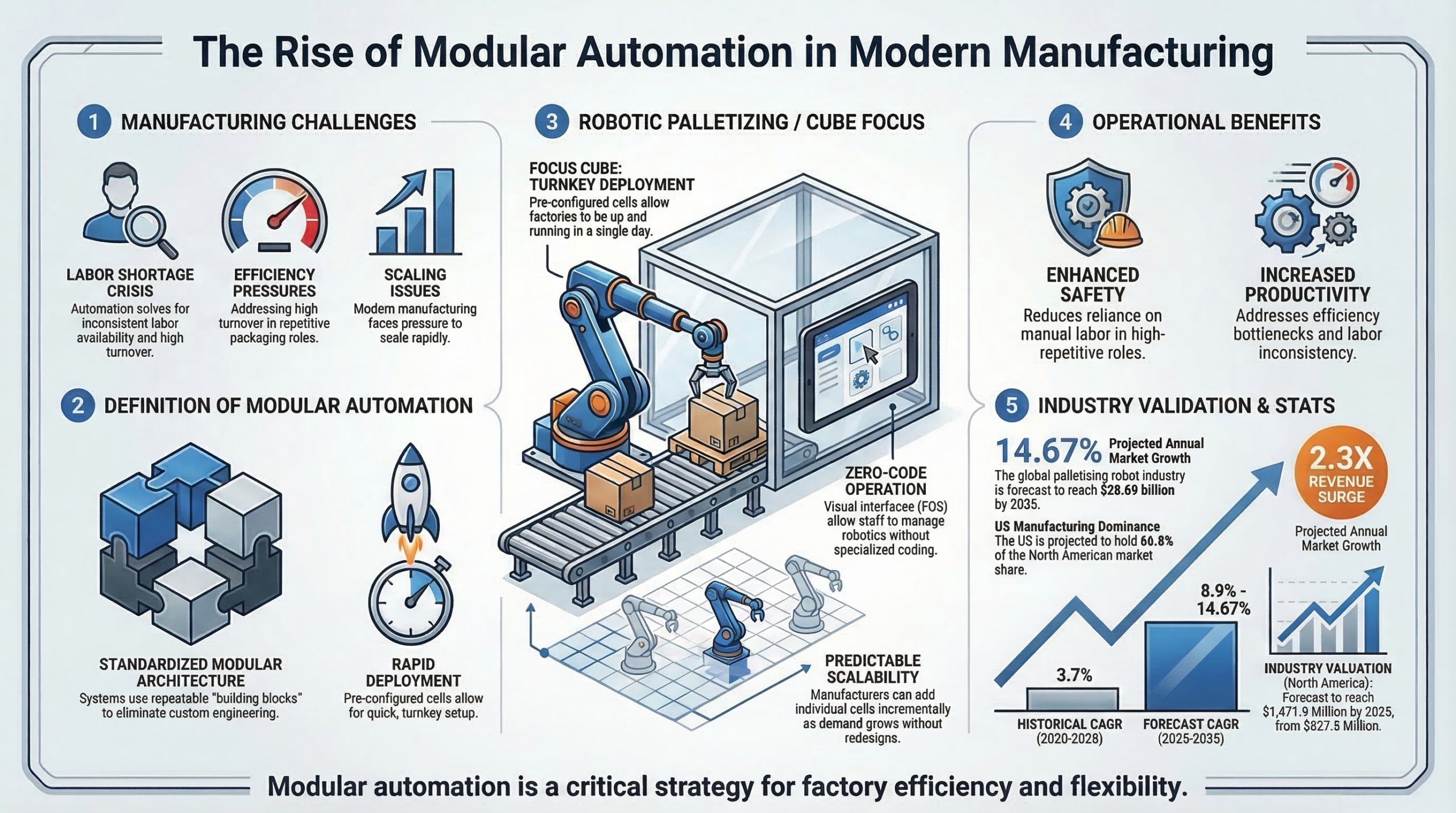
The Case for Modular Automation in Modern Manufacturing
Manufacturing leaders across North America are facing a convergence of pressures that would have seemed unlikely just a decade ago. Customer expectations for faster delivery continue to rise, product variety is increasing, and labor availability remains inconsistent in many regions. At the same time, manufacturers are under constant pressure to maintain cost competitiveness while improving safety and operational efficiency.
In this environment, automation is no longer simply a long-term technology investment. It has become a strategic operational decision.
However, the traditional approach to automation has not always aligned with the speed at which modern manufacturers need to adapt. Historically, large automation projects required months of engineering work, complex installation processes, and substantial capital commitments before delivering results. Systems were often designed from scratch, requiring custom layouts, extensive programming, and lengthy commissioning periods.
Today, a new approach is gaining traction: modular automation.
Modular automation systems are designed using standardized building blocks that can be deployed rapidly while still allowing customization for specific applications. Rather than reinventing the wheel for every installation, integrators develop repeatable architectures that dramatically shorten deployment timelines while maintaining flexibility.
One area where this model has proven particularly effective is robotic palletizing.
Palletizing is a critical step in nearly every manufacturing and packaging operation. Products must move from the production line into stable pallet loads that can be stored, transported, and distributed efficiently. Historically, this task relied heavily on manual labor, requiring workers to lift, stack, and organize cartons for extended periods.
While manual palletizing can be effective in small operations, it presents several long-term challenges for growing facilities. Repetitive lifting increases the risk of workplace injuries, staffing shortages can create bottlenecks in production, and inconsistent stacking patterns can compromise pallet stability.
Robotic palletizing systems address these issues by automating the process with precision and reliability.
Modern palletizing cells combine industrial robotics with integrated conveyors, safety systems, and intelligent controls. Products move along conveyor lines to a robotic pick point, where a robot lifts each box and places it into a defined stacking pattern on a pallet.
The robot performs the same task thousands of times per shift with consistent accuracy and speed.
What makes modular palletizing solutions particularly attractive is their predictable deployment process. Systems like the CUBE palletizing cell from FOCUS Integration demonstrate how modular architecture can transform the implementation timeline.
Instead of designing every component from scratch, the system is built around a standardized cell structure that integrates robotic technology, safety components, and conveyor interfaces into a compact and repeatable configuration.
This modular design dramatically simplifies installation.
Manufacturers can integrate the palletizing system with existing conveyor lines while minimizing disruption to production. Because the architecture has been refined across multiple deployments, commissioning time is reduced and operational reliability improves.
The advantages extend beyond installation.
Modular automation also improves scalability. Manufacturers can begin with a single palletizing cell and expand their automation footprint as production grows. Additional cells, conveyors, or robotic systems can be integrated into the facility over time without requiring a complete redesign of the production environment.
This approach allows automation to evolve alongside the business.
For many organizations, this incremental path to automation reduces both financial risk and operational complexity. Rather than committing to a large, multi-year automation initiative, companies can begin with targeted solutions that deliver immediate benefits.
From an operational perspective, the results are significant. Robotic palletizing systems improve throughput, maintain consistent pallet quality, and reduce reliance on manual labor for repetitive tasks. They also enhance workplace safety by removing one of the most physically demanding roles in the packaging process.
Equally important, these systems support a broader shift toward smarter manufacturing environments.
As factories adopt more connected equipment and data-driven production processes, modular automation solutions provide the flexibility needed to integrate with evolving technologies.
Manufacturers that embrace modular automation are not simply improving a single process. They are laying the groundwork for a production ecosystem that can adapt, scale, and compete in an increasingly dynamic industrial landscape.
The future of manufacturing will belong to organizations that can move quickly, implement technology effectively, and continuously refine their operations.
Modular automation is one of the most powerful tools available to make that future possible.
FOCUS Integration – Industry Deep Dive Episode 1 (Video Notes)
FOCUS Integration – Industry Deep Dive Episode 1 (Audio Notes)