
The Future of the Factory Interface:

Where Intelligence, Visualization, and Human-Centered Design Merge Into One Unified Experience**

Executive Summary

For decades, factory interfaces lagged behind the complexity of the machines they controlled.

Machines evolved.
Automation advanced.
Robotics became intelligent.
Sensors exploded in capability.
Production lines became hyper-fast.

But HMIs?
They mostly stayed the same.

Now, a seismic shift is underway.

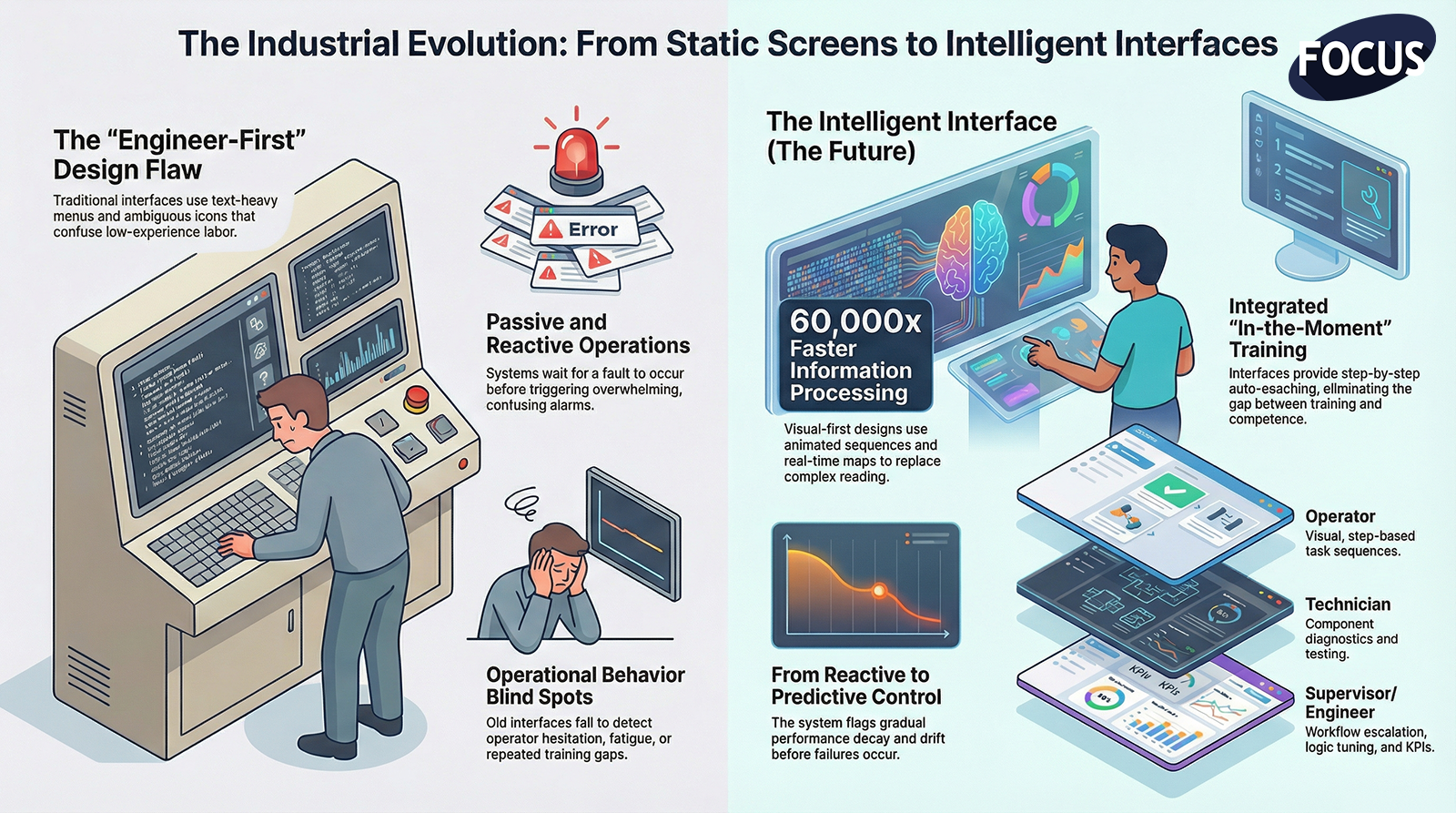
The Future Factory Interface is visual, predictive, layered, guided, and deeply aware of the people using it.
It transforms industrial work from intimidating to intuitive, from reactive to predictive, from confusing to clear.

This episode defines what tomorrow’s interface looks like — and why factories that adopt it will dominate the next decade of manufacturing.

  1. The Old Interface Paradigm Is Breaking Down

Traditional HMIs suffer from:

❌ Text-heavy layouts

❌ Nested menus

❌ Overwhelming alarms

❌ Ambiguous icons

❌ Minimal interactivity

❌ Engineer-first design

❌ Behavior blind spots

❌ Role confusion

These interfaces were never designed for:

  • High turnover
  • Low experience labor
  • Fast automation
  • Predictive technology
  • Multi-machine coordination
  • Visual learning
  • Modern operations

They confuse workers more than they empower them.

The future interface reverses this dynamic completely.

  1. The New Interface Is Visual-First and Text-Minimal

Humans process visual information 60,000× faster than text.

The future HMI uses:

✔ Animated sequences

✔ Real-time machine visualization

✔ Color-coded states

✔ Guided overlays

✔ Component highlighting

✔ Spatial maps

✔ Error illustrations

✔ Touch-based interaction

The user doesn’t need to read the system.
They need to see it.

  1. Intelligent Predictive Interfaces Replace Reactive Screens

Instead of waiting for faults, the future interface:

  • Warns of abnormal drift
  • Predicts failure windows
  • Shows gradual performance decay
  • Flags misalignment patterns
  • Monitors operator hesitation
  • Detects repeated errors
  • Suggests optimal action
  • Recommends improvements

This shifts the factory from reactive to preemptive control.

  1. Multi-Layered Depth Makes Complexity Safe and Simple

The future interface includes:

Operator Layer

Simple, visual, step-based.

Technician Layer

Diagnostics, tests, components.

Engineer Layer

Logic, tuning, configuration.

Supervisor Layer

Workflows, escalation, KPIs.

Everyone gets the interface they need —
not the one-size-fits-none screen of the past.

  1. The Interface Expands Beyond the HMI Screen

Factory interfaces will soon live across:

  • Large displays
  • Tablets
  • Wearable screens
  • Mobile devices
  • Machine towers
  • Digital dashboards
  • AR headsets
  • Multi-station visualization walls

The interface becomes a factory-wide experience, not a 10-inch panel on a steel enclosure.

  1. Direct Human Behavior Feedback Becomes Standard

The future interface understands:

  • Where operators hesitate
  • Which steps confuse them
  • What screens go unused
  • What actions create faults
  • Which instructions fail
  • Training gaps
  • Fatigue patterns
  • Repeated mistakes

This is behavior telemetry, and it enables:

✔ Better UI design

✔ Better workflows

✔ Better training

✔ Better automation

✔ Better safety

The interface starts learning from the people who use it.

  1. Training and Operation Merge Into One System

The future HMI is not a tool —
it is a trainer.

✔ Visual guides

✔ Step sequences

✔ Interactive instructions

✔ Auto-coaching

✔ Skill-level adaptation

✔ In-the-moment training

Operators don’t need to memorize.
The system teaches them as they work.

This eliminates the gap between “trained” and “competent”.

  1. The Interface Becomes the Brainstem of a Connected Factory

The factory interface will integrate:

✔ Robots

✔ Sensors

✔ Quality systems

✔ SCADA

✔ MES

✔ ERP

✔ Maintenance tools

✔ Digital OS layers

✔ Factory displays

Instead of isolated machines, the interface becomes a nervous system connecting every process, every role, and every decision.

  1. Safety Evolves From Passive Warnings to Active Prevention

The future interface doesn’t just show hazards —
it actively prevents unsafe actions.

✔ Guided recovery

✔ Automatic lockouts

✔ Hazard zone visualization

✔ Misuse prevention

✔ Real-time awareness

✔ Operator risk detection

Safety becomes automated, not reactive.

**10. Conclusion:

The Future of the Factory Interface Is Predictive, Visual, Layered, Connected, and Human-Centered**

In the next decade, factories will succeed or fail based on the quality of their interfaces.

The future interface delivers:

✔ Instant clarity

✔ Predictive behavior

✔ Role-based simplicity

✔ Visual guidance

✔ Automated training

✔ Connected intelligence

✔ Real-time telemetry

✔ Faster decision-making

✔ Safer interactions

The best factories won’t have complicated screens.
They’ll have intelligent, adaptive interfaces that empower every worker to succeed — instantly.

This is the next evolution in manufacturing.


FOCUS Integration – Episode 10 – The Future of Factory Interface (Video Notes)

FOCUS Integration – Episode 10 – The Future of Factory Interface (Audio Notes)
 

Cognitive Load Crisis

The Cognitive Load Crisis:

Why Modern Factories Are Overwhelming Workers (and How HMIs Must Fix It)**

Executive Summary

The modern factory has evolved faster than the human mind’s ability to keep up.

Automation has accelerated.
Production has intensified.
Complexity has multiplied.
Turnover has skyrocketed.

But human cognitive limits have not changed.

Operators, technicians, and supervisors are drowning in:

  • Alarms
  • Data
  • Steps
  • Screens
  • Instructions
  • Decisions
  • Distractions
  • Variability
  • Pressure

This overload creates errors, slows production, causes safety incidents, increases scrap, and drives people out of the industry.

This is not a performance problem.
This is not a training problem.
This is not a motivation problem.

This is a cognitive load problem — and modern HMIs must be redesigned to solve it.

  1. Humans Have Cognitive Limits — Factories Act Like They Don’t

The human brain can only process:

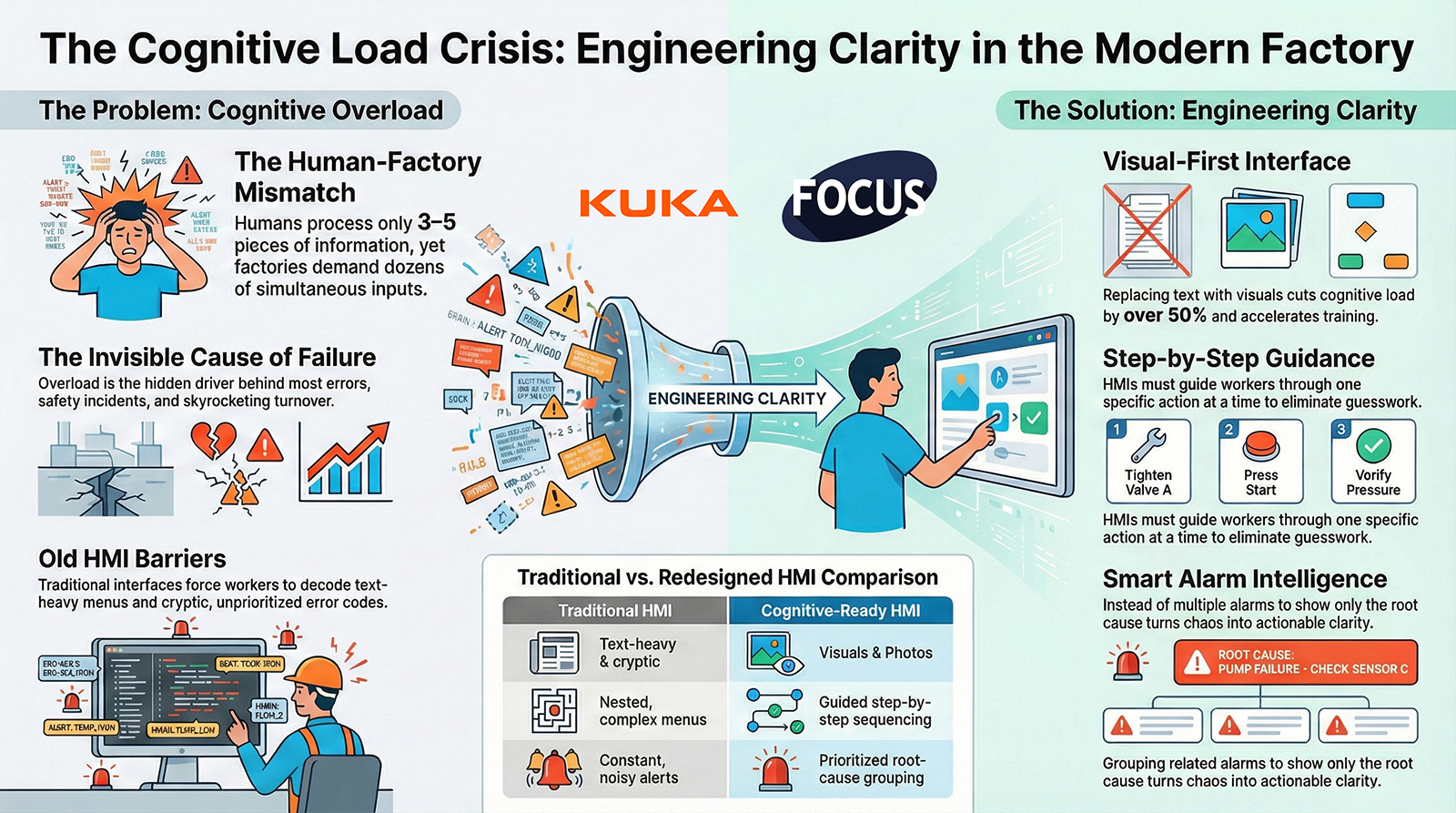
  • 3–5 pieces of new information at one time
  • Simple sequences
  • Clear visuals
  • Low ambiguity
  • Tasks with immediate feedback

But factories expect workers to juggle:

✔ Dozens of screens

✔ Multiple simultaneous alarms

✔ Complex mechanical understanding

✔ Tribal instructions

✔ Machine timing

✔ Quality expectations

✔ Safety rules

✔ Changeover steps

✔ Downtime pressure

The mismatch between expectation and ability is the root of modern operational chaos.

  1. Cognitive Overload Causes Most Factory Problems

When workers are mentally overwhelmed, they:

❌ Make mistakes

❌ Forget steps

❌ Miss cues

❌ React slowly

❌ Skip instructions

❌ Trigger faults

❌ Misinterpret alarms

❌ Perform unsafe actions

❌ Lose confidence

❌ Quit

Cognitive overload is not visible —
it’s not like a broken machine or a red alarm light —
but it is the invisible force behind most operational instability.

  1. Old HMIs Make Cognitive Load Worse

Traditional HMIs were built for engineers:

  • Tiny buttons
  • Text-heavy screens
  • Nested menus
  • Cryptic errors
  • Parameter overload
  • No visual hierarchy
  • No prioritization
  • No sequencing
  • No simplification

These interfaces increase cognitive load by forcing workers to interpret, decode, remember, and guess.

This is unacceptable in the modern factory.

  1. The Cognitive Load Crisis Hits New Workers the Hardest

New workers:

  • Have no tribal knowledge
  • Are less mechanically familiar
  • Need visual learning
  • Are overwhelmed by too much text
  • Lose confidence quickly
  • Leave if the job feels chaotic

If a new worker is overloaded in the first hour,
they will not survive the first week.

The HMI must make the factory understandable to the inexperienced instantly.

  1. Cognitive Load Must Be Engineered Down at the Interface Level

The only scalable solution is to redesign HMIs to:

✔ Reduce information quantity

✔ Prioritize essential tasks

✔ Show only what matters now

✔ Use visuals instead of text

✔ Guide step-by-step

✔ Predict what the user needs

✔ Block incorrect actions

✔ Minimize decision-making

✔ Highlight the critical path

✔ Reduce noise from alarms

This is how you engineer clarity.

This is how you reduce cognitive demand.

  1. The HMI Must Tell Workers EXACTLY What to Do — One Step at a Time

Cognitive load drops dramatically when workers are not asked to:

  • Remember sequences
  • Interpret ambiguous instructions
  • Decode technical jargon
  • Navigate unfamiliar screens
  • Make high-risk decisions under pressure

A modern HMI should guide:

✔ Step 1 → do this

✔ Step 2 → now this

✔ Step 3 → verify

✔ Step 4 → confirm

Nothing more.
Nothing less.
Nothing confusing.

This transforms performance.

  1. Visual-First Design Cuts Cognitive Load by Over 50%

When you replace text with visuals:

  • Recognition replaces interpretation
  • Processing is instant
  • Error rates drop
  • Training accelerates
  • Stress levels fall
  • Memory burden disappears

Examples:

  • Green check / red X visuals
  • Animated steps
  • Photos of correct positions
  • Side-by-side quality comparisons
  • Highlighted sensor locations
  • Visual zone maps

Humans are visual.
HMIs must reflect that.

  1. Smarter Alarm Systems Reduce Cognitive Load During Chaos

Alarms overwhelm workers:

  • Too many
  • Too cryptic
  • Too technical
  • Too frequent
  • Too urgent
  • Too unclear

Modern alarm intelligence:

✔ Groups related alarms

✔ Prioritizes the root cause

✔ Hides nuisance alarms

✔ Shows only the actionable step

✔ Provides a visual recovery guide

This turns alarm storms into clarity storms.

  1. Reducing Cognitive Load Increases Speed, Quality, and Safety

When cognitive load is low:

✔ Operators move faster

✔ Recovery times shrink

✔ Mistakes disappear

✔ Safety improves

✔ Training becomes easy

✔ Turnover drops

✔ Consistency rises

✔ Confidence skyrockets

Humans perform at their best when the system supports them instead of overwhelming them.

**10. Conclusion:

Solving the Cognitive Load Crisis Is the Key to the Modern Factory**

Factories don’t fail because people are bad at their jobs.
Factories fail because systems overwhelm people.

The Cognitive Load Crisis is the invisible barrier stopping:

  • Training effectiveness
  • Standard work
  • Safety culture
  • Quality performance
  • Operational speed
  • Employee retention
  • Automation readiness

Modern HMIs can fix this by:

✔ Simplifying

✔ Visualizing

✔ Prioritizing

✔ Sequencing

✔ Predicting

✔ Guiding

✔ Supporting

This is not a UX upgrade.
This is a workforce revolution.

Reducing cognitive load is how factories survive the next decade.


FOCUS Integration – Episode 5 – Cognitive Load Crisis (Video Notes)


FOCUS Integration – Episode 5 – Cognitive Load Crisis (Audio Notes)