
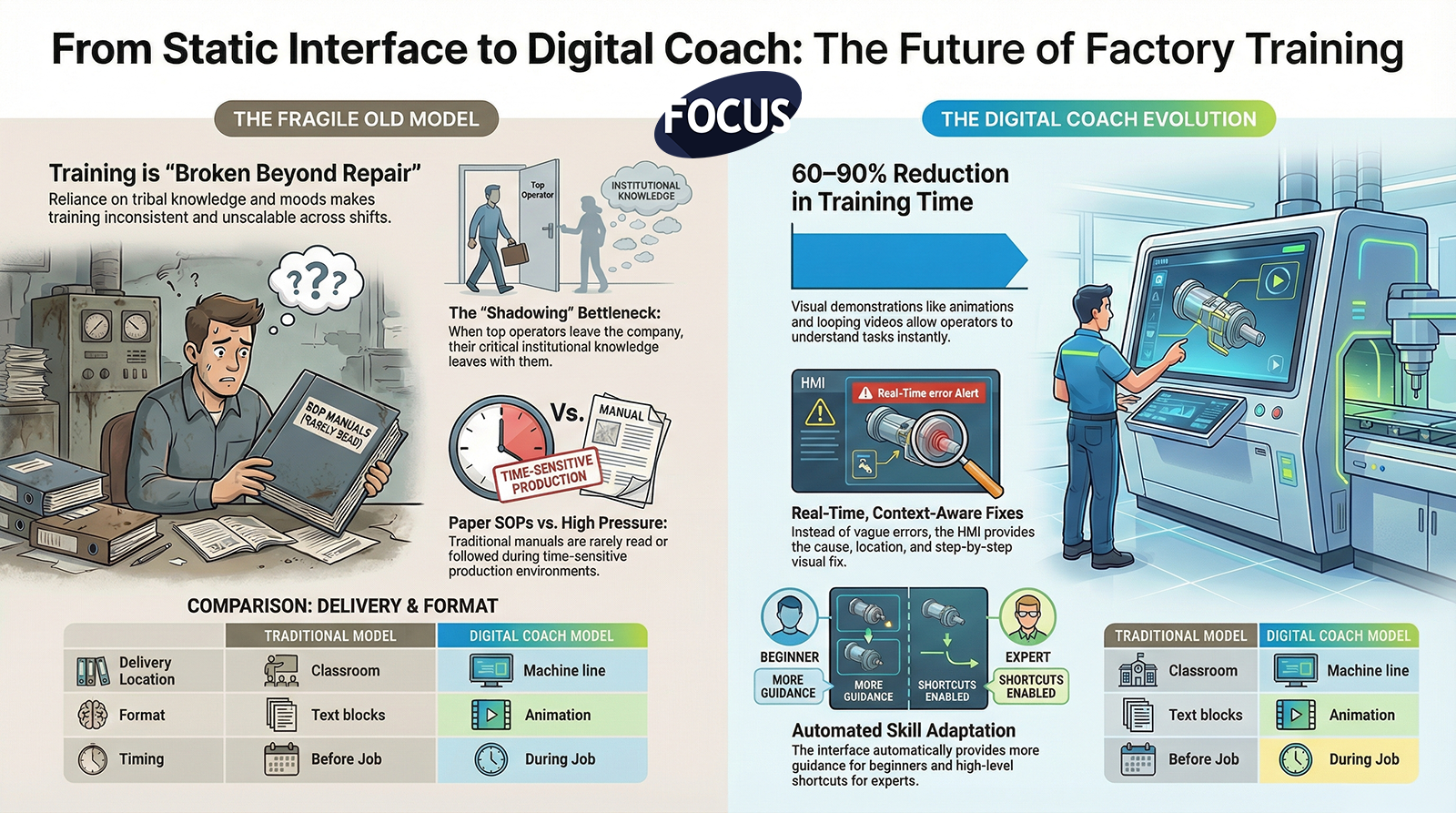
The HMI as a Digital Coach:
How Modern Interfaces Will Train Workers Automatically On the Line**
Executive Summary
For decades, factories have relied on three fragile systems of training:
- Shadowing — which is inconsistent
- Tribal knowledge — which is unreliable
- Paper SOPs — which nobody reads under pressure
The result?
- Operators feel unprepared
- Supervisors feel frustrated
- Maintenance feels overwhelmed
- Quality feels unsupported
- Engineers feel misunderstood
- Management feels defeated
Training has always been a bottleneck in manufacturing.
But that bottleneck disappears the moment the HMI evolves from a static interface into a dynamic digital coach capable of training workers automatically, continuously, and precisely at the moment instruction is needed.
This is the future of manufacturing skill development.
- The Old Training Model Is Broken Beyond Repair
Traditional operator training depends on:
- The trainer’s personality
- The trainer’s memory
- The trainer’s mood
- The trainer’s availability
- The trainer’s experience
- And whether the trainee was paying attention that day
This creates massive inconsistencies:
- Two operators trained on the same machine perform differently
- Shifts disagree on how things should be done
- Quality issues appear randomly
- Maintenance receives vague problem descriptions
- Safety behaviors vary
- Supervisors rely on assumptions
Worst of all — when top operators leave, their knowledge leaves with them.
The old model cannot scale.
The digital coach can.
- The Digital Coach Lives Inside the HMI
In the next-generation factory, training no longer happens:
- In classrooms
- In meetings
- In binders
- In notebooks
- In tribal memory
It happens on the line, through the HMI, during real work.
A digital coach:
- Shows the operator what to do
- Demonstrates how to do it
- Explains why it matters
- Alerts when something is done incorrectly
- Corrects the behavior instantly
- Reinforces good habits
- Logs training progress
- Tracks skill competency
This means the HMI doesn’t just control the machine—it develops the worker.
- Training Becomes Embedded Into the Job, Not External to It
Traditional training happens before the job.
Digital coaching happens during the job.
This solves multiple issues:
✔ Operators no longer forget steps
✔ Training starts immediately upon hiring
✔ Skill gaps disappear in real time
✔ Operators learn in the exact context the action is needed
✔ Work becomes protected from mistakes
✔ Training is standardized across all shifts
No more:
- “Well Bob taught me to do it this way.”
- “I didn’t know that step mattered.”
- “That’s not how I was trained.”
The HMI becomes the single source of truth.
- The Digital Coach Uses Visual Demonstrations, Not Text Blocks
People learn faster through visuals.
The digital coach provides:
- Animations
- Short looping videos
- Photos of real machine components
- Step illustrations
- Directional arrows
- “What good looks like” images
- Exploded views
- Before/after comparisons
Operators understand instantly.
This reduces training time by 60–90%.
- The Digital Coach Explains Every Alarm and Guides Every Fix
When something goes wrong, the digital coach doesn’t just throw an error on the screen.
It provides:
- The cause of the error
- The location of the issue
- A visual of the component
- The step-by-step fix
- A check to confirm correction
- Suggestions for prevention
This is real-time, context-aware training.
Every alarm becomes a learning moment, not a frustration.
- The Digital Coach Adjusts to Operator Skill Level
Beginner operators see:
- More guidance
- More steps
- More visuals
- Slower pacing
- Context explanations
Experienced operators see:
- Shortcut workflows
- Higher-level options
- Less hand-holding
- Advanced troubleshooting
Skill development becomes automated.
- The Digital Coach Reinforces Correct Behavior Through Feedback
The HMI acknowledges and builds habits:
- “Great job — sensor cleared.”
- “Correct placement detected.”
- “Verification complete.”
- “Step executed perfectly.”
Positive reinforcement is one of the most powerful training accelerators.
Small wins build confidence.
Confidence builds independent capability.
Capability builds retention.
- The Digital Coach Tracks Competency Automatically
Behind the scenes, the HMI collects data on:
- Tasks completed
- Mistakes corrected
- Steps skipped
- Time per action
- Alarm responses
- Troubleshooting paths taken
- Required resets
- Safety confirmations
This data supports:
- Certification
- Performance development
- Supervisor insight
- Training optimization
- Career progression
Skill becomes measurable.
And once it’s measurable, it’s manageable.
- The Digital Coach Ensures Every Shift Operates Identically
One of the biggest problems in manufacturing is shift-to-shift inconsistency.
The digital coach eliminates this by:
- Standardizing workflows
- Enforcing sequence
- Embedding verification
- Preventing unauthorized shortcuts
- Making tribal knowledge irrelevant
Every shift works the same way.
Every operator follows the same steps.
Every machine is run correctly.
Consistency becomes automatic.
**10. Conclusion:
The HMI of the Future Doesn’t Just Display Information — It Teaches.**
Factories used to say:
- “We can’t find skilled people.”
- “We don’t have time to train.”
- “We lose too much knowledge when people leave.”
- “Operators make too many mistakes.”
- “Training doesn’t stick.”
- “Every shift does things differently.”
The Digital Coach solves all of it.
Because the future of manufacturing belongs to the systems that:
- Teach automatically
- Guide precisely
- Correct instantly
- Reduce cognitive load
- Build confidence
- Protect quality
- Speed up training
- Eliminate guesswork
This isn’t just a new HMI.
This is a new model for how humans learn and perform inside a factory.
It changes everything.
FOCUS Integration – Episode 7 – The HMI as a Digital Coach (Video Notes)
FOCUS Integration – Episode 7 – The HMI as a Digital Coach (Audio Notes)