
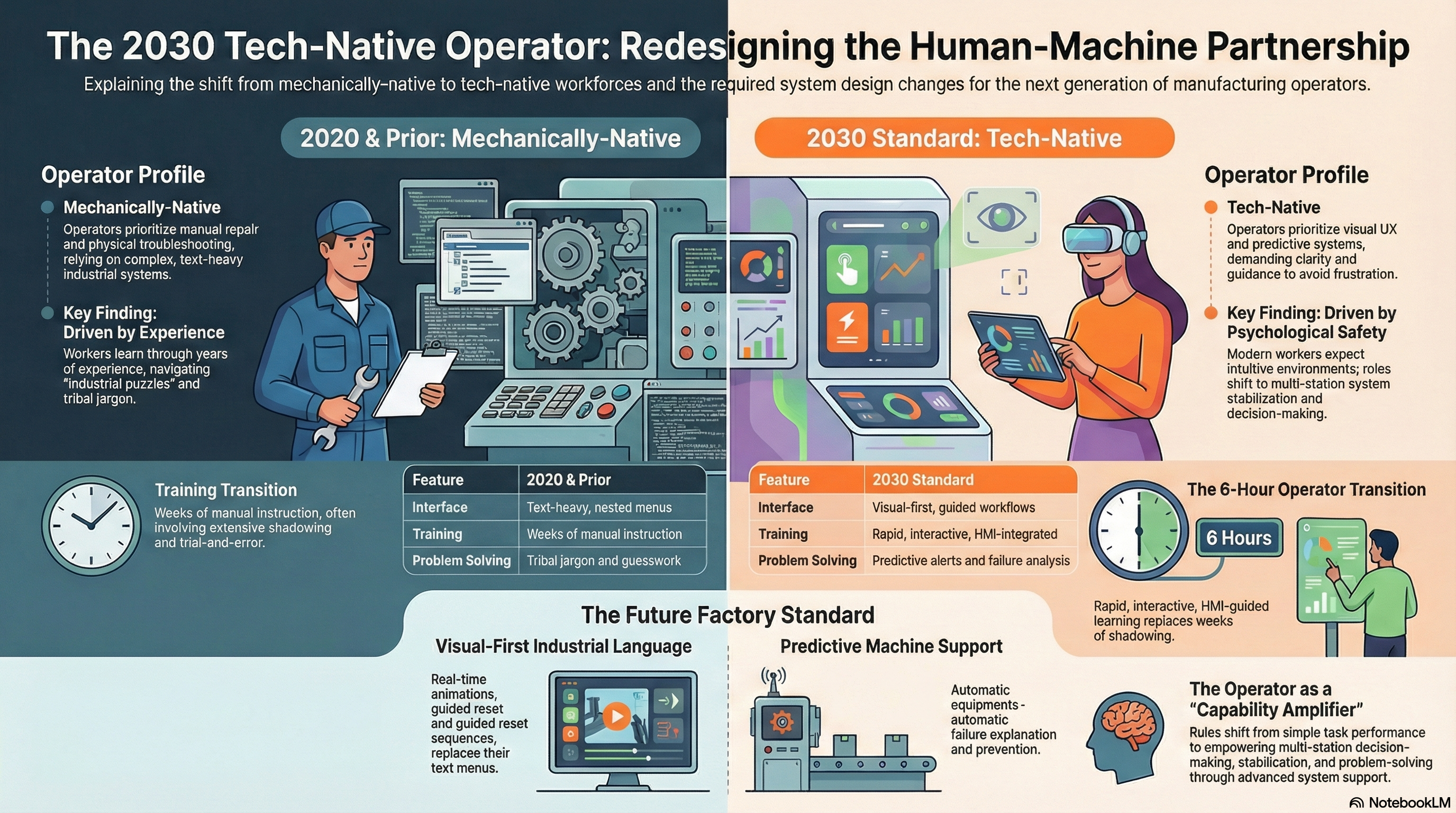
The Next Generation Workforce Built for Speed, Clarity, Technology, and Intelligent Automation**
Executive Summary
Manufacturing has entered a new era —
one where automation is smarter, faster, and more accessible than ever before.
But the biggest shift is not the machines.
It’s the people.
The operator of 2030 is not the operator of 2020, 2010, or 1990.
They are:
- More tech-native
- More visual
- More adaptable
- Less mechanically trained
- Less patient with complexity
- More comfortable with automation
- More dependent on clear guidance
- More motivated by impact and confidence
- Less tolerant of confusing systems
- More capable inside the right environment
The factories that understand who the 2030 operator is —
and design their systems around them —
will lead the next industrial decade.
- The 2030 Operator Is Tech-Native, Not Mechanically-Native
The workforce entering manufacturing in 2030 grew up with:
- Smartphones
- Touchscreens
- Instant information
- Visual UX
- Predictive systems
- Guided interfaces
- Automation everywhere
But they did not grow up with:
- Mechanical repair
- Industrial wiring
- Manual machinery
- Physical troubleshooting
- Complex industrial HMIs
Factories must evolve their interfaces to match the way the new workforce thinks and learns.
This is why visual-first design becomes the dominant industrial language.
- The 2030 Operator Needs Clarity, Not Complexity
The new workforce is overwhelmed by:
❌ Text-heavy HMIs
❌ Nested menus
❌ Ambiguous alarms
❌ Tribal jargon
❌ Guesswork-based troubleshooting
They thrive with:
✔ Visual cues
✔ Guided steps
✔ Clear workflows
✔ Real-time animation
✔ Predictive warnings
✔ Step-by-step reset sequences
The Operator of 2030 expects intuitive interfaces, not industrial puzzles.
- The 2030 Operator Will Learn Faster Than Any Workforce Before — When Trained Correctly
By 2030, training that takes weeks will be unacceptable.
Training must be:
- Rapid
- Visual
- Interactive
- In the flow of work
- Guided at the HMI
- Reinforced through telemetry
- Supported by automatic correction
- Separated by role
This is why the 6-hour operator transition becomes the new normal.
2030 operators don’t need more training time.
They need better training architecture.
- The 2030 Operator Expects Predictive Support From the Machine
They grew up with:
- Google autofill
- GPS rerouting
- Smart notifications
- Predictive text
- Automatic error correction
- AI-driven recommendations
So they expect the same from industrial equipment.
They assume machines will:
✔ Warn them early
✔ Guide them clearly
✔ Prevent them from making mistakes
✔ Show them the correct reset path
✔ Explain what went wrong
✔ Help them succeed
And when machines don’t behave this way, they lose trust in the system.
- The 2030 Operator Will Thrive in a Unified Factory Ecosystem
Because:
- Interfaces match
- Workflows match
- Alarms match
- Escalation paths match
- Visual rules match
- Training structure matches
The Operator of 2030 becomes cross-functional, not machine-dependent.
Factories achieve:
✔ Flexible staffing
✔ Faster shift changes
✔ Lower downtime
✔ Lower turnover
✔ Faster response times
✔ Stronger engagement
Unified factories don’t just help processes —
they help people.
- The 2030 Operator Will Rely Heavily on Smart Escalation
Instead of:
- Guessing
- Asking around
- Waiting for maintenance
- Hoping for answers
2030 operators use:
✔ Clear escalation workflows
✔ Visual error insights
✔ Priority-based alerts
✔ Automated notifications
✔ Guided failure analysis
✔ Technician-layer handoff
This makes them:
- Proactive
- Confident
- Effective
- Independent
And it makes supervisors far more capable.
- The 2030 Operator Will Expect Real-Time Feedback on Performance
They grew up in a world of:
- Metrics
- Scores
- Streaks
- Instant feedback systems
- Gamified learning
Factories that provide real-time feedback unlock:
- Better engagement
- Faster learning
- Safer behavior
- Clear goals
- Higher performance
Telemetry becomes not just a tool —
but a motivational engine.
- The 2030 Operator Will Demand Psychological Safety
Psychological safety is the invisible requirement of modern work.
Operators of 2030 will not tolerate:
❌ Confusion
❌ Blame
❌ Unsafe systems
❌ Overly complex tasks
❌ Poorly designed HMIs
They expect:
✔ Guidance
✔ Support
✔ Clarity
✔ Predictability
✔ Confidence
Factories built for the 2030 operator will have far lower turnover and far higher skill progression.
- The Operator of 2030 Will Become a High-Value Asset — Not a Task Performer
With clearer systems, better interfaces, and predictive automation, the operator becomes:
- A decision-maker
- A system ambassador
- A process stabilizer
- A multi-station specialist
- A capability amplifier
Their role shifts from:
“Run the machine”
to
“Elevate the system.”
This is the true evolution of the human-machine partnership.
**10. Conclusion:
The Operator of 2030 Is the Reason the Unified Factory Exists**
Everything we have covered — speed, training, clarity, plug-and-play, unified HMIs, predictive support — exists for one purpose:
To empower the next generation of operators to succeed instantly.
The Operator of 2030 is:
✔ Faster to train
✔ Easier to support
✔ More adaptable
✔ More capable
✔ More confident
✔ More engaged
✔ More aligned with automation
Factories that design for this new workforce will dominate the next decade.
Factories that don’t will fall behind quickly.
The future of manufacturing is not machines replacing people.
It is better machines enabling better people.
FOCUS Integration – Episode 7 – Operators of 2030 (Video Notes)
FOCUS Integration – Episode 8 – Operators of 2030 (Audio Notes)