
Rapid Training

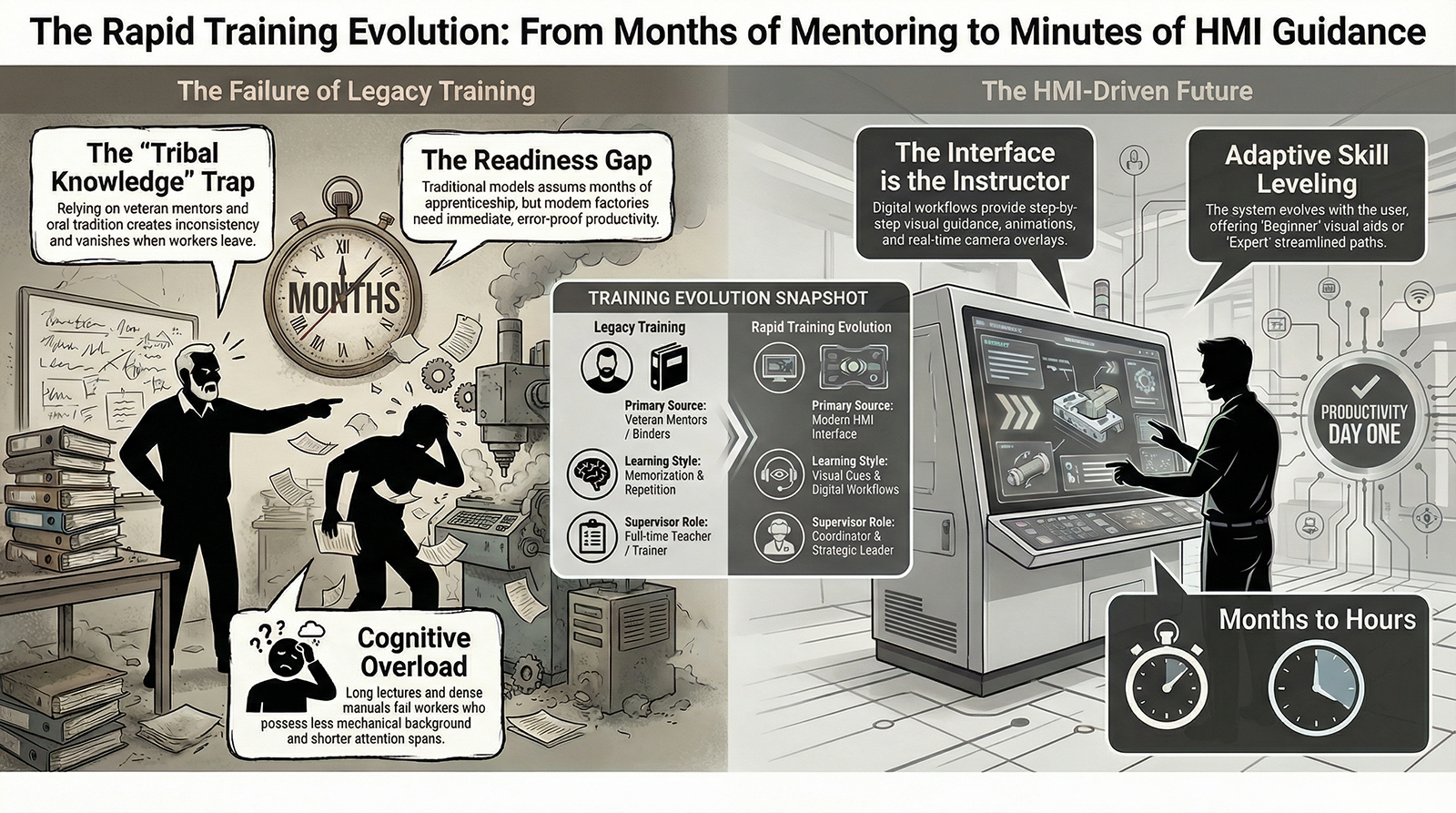
The Rapid Training Evolution:

How Modern HMIs Cut Training Time From Months to Hours**

Executive Summary

The manufacturing workforce has changed forever.

Turnover is higher.
Experience is lower.
Attention spans are shorter.
Tribal knowledge is evaporating.
Machines are more complex.
Expectations are increasing.

Factories used to rely on:

  • Shadowing
  • Oral tradition
  • Long apprenticeships
  • Classroom sessions
  • Repetition
  • Veteran mentoring
  • Trial-and-error

That era is gone.

Factories now need workers ready on Day One.
Not after six weeks.
Not after ten cycles of mistakes.
Not after being babysat by a senior operator.

This is the Rapid Training Evolution
a new training model built around modern HMIs that teach as you work, guide every action, eliminate guesswork, and create instant capability.

Training doesn’t happen before the job.
Training happens in the job.

And it evolves as fast as the workforce demands.

  1. Traditional Training Cannot Keep Up With Modern Manufacturing

Legacy training models assume:

  • Workers stay for years
  • Apprenticeship is normal
  • People learn mechanically through repetition
  • Experienced mentors are always available
  • Workers absorb dense technical information

But the reality is:

❌ Workers come with little mechanical background

❌ New hires have minutes of attention, not days

❌ Turnover wipes out knowledge

❌ Veteran operators are overbooked

❌ Training time destroys production time

❌ Complexity grows faster than capability

Factories need training that adapts to the worker — not the other way around.

  1. The Rapid Training Evolution Delivers Skill Through the HMI Itself

Modern HMIs must do more than display information.

They must:

✔ Teach

✔ Guide

✔ Explain

✔ Confirm

✔ Warn

✔ Correct

✔ Sequence

✔ Coach

✔ Support

The HMI becomes the primary trainer.

Not a supervisor.
Not a binder.
Not a tribal expert.
Not a classroom.

The interface becomes the instructor.

This is the future.

  1. Training Becomes Visual, Not Verbal

Traditional training requires:

  • Listening
  • Memorizing
  • Note-taking
  • Remembering steps
  • Interpreting explanations
  • Asking clarifying questions

Modern workers struggle with this.

The Rapid Training Evolution replaces lectures with visuals:

✔ Animations

✔ Photos of correct orientation

✔ Videos of each step

✔ Highlighted components

✔ Before/after visuals

✔ Quality comparison images

✔ Real-time camera overlays

Humans don’t learn best from words.
They learn best from seeing.

  1. Step-by-Step Guided Workflows Become Digital Training

Instead of teaching a changeover once and hoping it sticks, the HMI:

✔ Guides the user

✔ Locks sequence

✔ Shows visual confirmation

✔ Blocks dangerous actions

✔ Removes unnecessary steps

✔ Times progress

✔ Confirms completion

✔ Tracks common mistakes

This turns the changeover from a “tribal event” into a repeatable, error-proofed training sequence.

Workers learn the correct way — and only the correct way.

  1. Training Evolves in Real Time as Users Interact With the System

The system adapts to the user:

Beginner Mode

  • More visuals
  • Slower pacing
  • More confirmations
  • More training tips

Intermediate Mode

  • Faster navigation
  • Condensed steps
  • Fewer prompts

Expert Mode

  • Quick access
  • Streamlined paths
  • Advanced troubleshooting tools

Training evolves as the worker evolves.

  1. The Rapid Training Evolution Eliminates the Dependency on Tribal Knowledge

Factories used to rely on:

“Ask Bill, he knows the trick.”
“Only Maria knows how to fix that jam.”
“You’ll learn it when you see it happen.”
“That’s just how we’ve always done it.”

This destroys consistency.

Modern HMIs:

  • Capture expert knowledge
  • Convert it into digital workflows
  • Deliver it at the exact moment it’s needed
  • Make every operator capable
  • Preserve knowledge permanently

Tribal knowledge becomes digital knowledge.

  1. The Rapid Training Evolution Accelerates Maintenance Capability

Maintenance used to take:

  • Years of experience
  • Tribal onboarding
  • Deep mechanical familiarity
  • Pattern recognition
  • Trial-and-error under pressure

Now the HMI provides:

✔ Fault explanation

✔ Likely causes

✔ Visual component maps

✔ Step-by-step repair sequences

✔ Predictive warnings

✔ Required tools checklists

✔ Verification steps

Maintenance techs become productive dramatically faster.

  1. Supervisors Shift From Trainers to Coordinators

Traditional supervisors spend:

  • 30% of their time training
  • 40% correcting mistakes
  • 20% troubleshooting
  • 10% actually supervising
  • 0% improving anything

With modern HMIs:

✔ The HMI trains

✔ The HMI guides

✔ The HMI enforces sequence

✔ The HMI documents performance

✔ The HMI flags skill gaps

Supervisors stop being teachers —
they become leaders.

  1. The Rapid Training Evolution Reduces Turnover

Workers leave because:

  • They feel confused
  • They feel overwhelmed
  • They feel unsupported
  • They feel like they are failing
  • They feel unsafe
  • They don’t understand the job

The new HMI experience:

✔ Builds confidence

✔ Reduces stress

✔ Creates clarity

✔ Makes success obvious

✔ Gives instant feedback

✔ Makes the job easier

Confidence is retention.
Clarity is retention.
Guidance is retention.

**10. Conclusion:

The Rapid Training Evolution Is Not Optional — It Is Survival**

Factories cannot rely on:

  • Classroom learning
  • Long apprenticeship
  • Veteran mentoring
  • Mechanical intuition
  • Memorized steps
  • Trial-and-error
  • Old HMIs
  • Tribal expertise

The modern workforce requires:

✔ Immediate capability

✔ Visual instruction

✔ Step-by-step workflows

✔ Predictive guidance

✔ Skill-on-demand

✔ Training built into the interface

This is the Rapid Training Evolution.

Training is no longer something workers receive.

Training is something the system provides — continuously, visually, and intelligently.

This is how factories will thrive in the next decade.

FOCUS Integration – Episode 9 – The Rapid Training Revolution (Video Notes)
https://youtu.be/sOKgXNQICDE

FOCUS Integration – Episode 9 – The Rapid Training Revolution (Audio Notes)
The HMI as a Digital Coach:

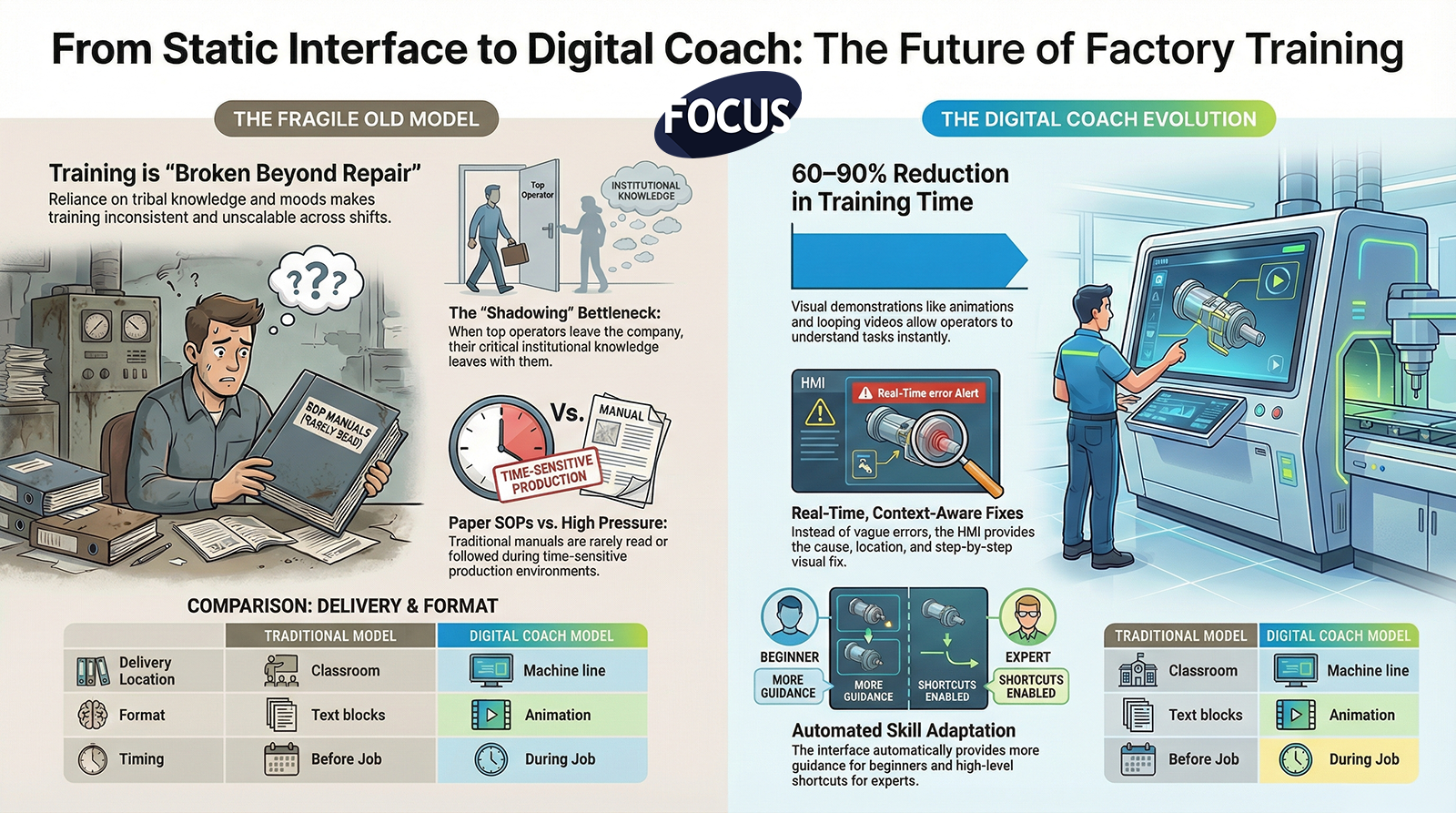
How Modern Interfaces Will Train Workers Automatically On the Line**

Executive Summary

For decades, factories have relied on three fragile systems of training:

  1. Shadowing — which is inconsistent
  2. Tribal knowledge — which is unreliable
  3. Paper SOPs — which nobody reads under pressure

The result?

  • Operators feel unprepared
  • Supervisors feel frustrated
  • Maintenance feels overwhelmed
  • Quality feels unsupported
  • Engineers feel misunderstood
  • Management feels defeated

Training has always been a bottleneck in manufacturing.

But that bottleneck disappears the moment the HMI evolves from a static interface into a dynamic digital coach capable of training workers automatically, continuously, and precisely at the moment instruction is needed.

This is the future of manufacturing skill development.

  1. The Old Training Model Is Broken Beyond Repair

Traditional operator training depends on:

  • The trainer’s personality
  • The trainer’s memory
  • The trainer’s mood
  • The trainer’s availability
  • The trainer’s experience
  • And whether the trainee was paying attention that day

This creates massive inconsistencies:

  • Two operators trained on the same machine perform differently
  • Shifts disagree on how things should be done
  • Quality issues appear randomly
  • Maintenance receives vague problem descriptions
  • Safety behaviors vary
  • Supervisors rely on assumptions

Worst of all — when top operators leave, their knowledge leaves with them.

The old model cannot scale.

The digital coach can.

  1. The Digital Coach Lives Inside the HMI

In the next-generation factory, training no longer happens:

  • In classrooms
  • In meetings
  • In binders
  • In notebooks
  • In tribal memory

It happens on the line, through the HMI, during real work.

A digital coach:

  • Shows the operator what to do
  • Demonstrates how to do it
  • Explains why it matters
  • Alerts when something is done incorrectly
  • Corrects the behavior instantly
  • Reinforces good habits
  • Logs training progress
  • Tracks skill competency

This means the HMI doesn’t just control the machine—it develops the worker.

  1. Training Becomes Embedded Into the Job, Not External to It

Traditional training happens before the job.
Digital coaching happens during the job.

This solves multiple issues:

✔ Operators no longer forget steps

✔ Training starts immediately upon hiring

✔ Skill gaps disappear in real time

✔ Operators learn in the exact context the action is needed

✔ Work becomes protected from mistakes

✔ Training is standardized across all shifts

No more:

  • “Well Bob taught me to do it this way.”
  • “I didn’t know that step mattered.”
  • “That’s not how I was trained.”

The HMI becomes the single source of truth.

  1. The Digital Coach Uses Visual Demonstrations, Not Text Blocks

People learn faster through visuals.

The digital coach provides:

  • Animations
  • Short looping videos
  • Photos of real machine components
  • Step illustrations
  • Directional arrows
  • “What good looks like” images
  • Exploded views
  • Before/after comparisons

Operators understand instantly.

This reduces training time by 60–90%.

  1. The Digital Coach Explains Every Alarm and Guides Every Fix

When something goes wrong, the digital coach doesn’t just throw an error on the screen.

It provides:

  1. The cause of the error
  2. The location of the issue
  3. A visual of the component
  4. The step-by-step fix
  5. A check to confirm correction
  6. Suggestions for prevention

This is real-time, context-aware training.

Every alarm becomes a learning moment, not a frustration.

  1. The Digital Coach Adjusts to Operator Skill Level

Beginner operators see:

  • More guidance
  • More steps
  • More visuals
  • Slower pacing
  • Context explanations

Experienced operators see:

  • Shortcut workflows
  • Higher-level options
  • Less hand-holding
  • Advanced troubleshooting

Skill development becomes automated.

  1. The Digital Coach Reinforces Correct Behavior Through Feedback

The HMI acknowledges and builds habits:

  • “Great job — sensor cleared.”
  • “Correct placement detected.”
  • “Verification complete.”
  • “Step executed perfectly.”

Positive reinforcement is one of the most powerful training accelerators.

Small wins build confidence.
Confidence builds independent capability.
Capability builds retention.

  1. The Digital Coach Tracks Competency Automatically

Behind the scenes, the HMI collects data on:

  • Tasks completed
  • Mistakes corrected
  • Steps skipped
  • Time per action
  • Alarm responses
  • Troubleshooting paths taken
  • Required resets
  • Safety confirmations

This data supports:

  • Certification
  • Performance development
  • Supervisor insight
  • Training optimization
  • Career progression

Skill becomes measurable.

And once it’s measurable, it’s manageable.

  1. The Digital Coach Ensures Every Shift Operates Identically

One of the biggest problems in manufacturing is shift-to-shift inconsistency.

The digital coach eliminates this by:

  • Standardizing workflows
  • Enforcing sequence
  • Embedding verification
  • Preventing unauthorized shortcuts
  • Making tribal knowledge irrelevant

Every shift works the same way.
Every operator follows the same steps.
Every machine is run correctly.

Consistency becomes automatic.

**10. Conclusion:

The HMI of the Future Doesn’t Just Display Information — It Teaches.**

Factories used to say:

  • “We can’t find skilled people.”
  • “We don’t have time to train.”
  • “We lose too much knowledge when people leave.”
  • “Operators make too many mistakes.”
  • “Training doesn’t stick.”
  • “Every shift does things differently.”

The Digital Coach solves all of it.

Because the future of manufacturing belongs to the systems that:

  • Teach automatically
  • Guide precisely
  • Correct instantly
  • Reduce cognitive load
  • Build confidence
  • Protect quality
  • Speed up training
  • Eliminate guesswork

This isn’t just a new HMI.

This is a new model for how humans learn and perform inside a factory.

It changes everything.

FOCUS Integration – Episode 7 – The HMI as a Digital Coach (Video Notes)


FOCUS Integration – Episode 7 – The HMI as a Digital Coach (Audio Notes)